(Answers to last week’s organic puzzler at the end of this post).

One of the more remarkable results from Jeff Volek’s laboratory in the past few years was the demonstration that when the blood of volunteers was assayed for saturated fatty acids (SFA), those subjects who had been on a very low-carbohydrate diet had lower levels than those on an isocaloric low-fat diet. This, despite the fact that the low-carbohydrate diet had three times the amount of saturated fat as the low-fat diet. How is this possible? What happened to the saturated fat in the low-carbohydrate diet? Well, that’s what metabolism does. The saturated fat in the low-carbohydrate arm was oxidized while (the real impact of the study) the low-fat arm is making new saturated fatty acid. Volek’s former student Cassandra Forsythe extended the idea by showing how, even under eucaloric conditions (no weight loss) dietary fat has relatively small impact on plasma fat.

The essential point of what I now call the Volek-Westman principle — we should be speaking of basic principles because the idea is more important than specific diets where it is impossible to get any agreement on definitions — the principle is that carbohydrate, directly or indirectly through insulin and other hormones, controls what happens to ingested (or stored) fatty acids. The motto of the Nutrition & Metabolism Society is: “A high fat diet in the presence of carbohydrate is different than a high fat diet in the presence of low carbohydrate.” Widely attributed to me, it is almost certainly something I once said although it has been said by others and the studies from Volek’s lab give you the most telling evidence.
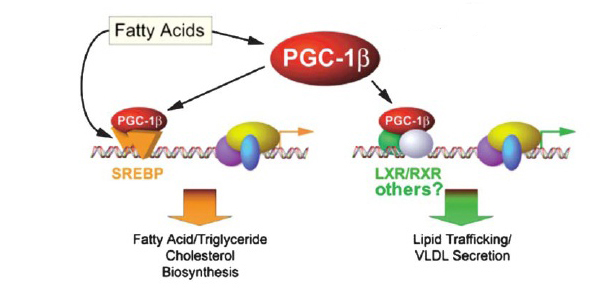
The question is critical. Whereas the scientific evidence now establishes that dietary saturated fat has no effect on cardiovascular disease, obesity or anything else, plasma saturated fatty acids can be a cellular signal and if you study the effect of dietary saturated fatty acids under conditions where carbohydrate is high and/or in rodents where plasma fat better correlates with dietary fat, then you will confuse plasma fat with dietary fat. An important study identified potential cellular elements in control of gene transcription that bear on lipid metabolism.

So, it is important to know about plasma saturated fatty acids. First, recall that strictly speaking there are only saturated fatty acids (SFA) — this is explained in detail in an earlier post.  What is called saturated fats simply mean those fats that have a high percentage of SFAs — things that we identify as “saturated fats,” like butter, are usually only 50 % saturated fatty acids (coconut oil is probably the only fat that is almost entirely saturated fatty acids but because they are medium chain length, they are usually considered a special case).

In Volek’s study, 40 overweight subjects were randomly assigned either to a carbohydrate-restricted diet (abbreviated CRD; %CHO:fat:protein = 12:59:28) or to a low fat diet, (LFD; %CHO:fat:protein = 56:24:20). The group was unusual in that they were all overweight would be characterized as having metabolic syndrome, in particular they all had, atherogenic dyslipidemia, which is the term given to a poor lipid profile (high triacylglycerol (TAG), low HDL-C, high small-dense LDL (so-called pattern B)). Metabolic syndrome (MetS) is the predisposition to CVD and diabetes and is characterized by the constellation of overweight, atherogenic dyslipidemia and, by now, a dozen other markers.
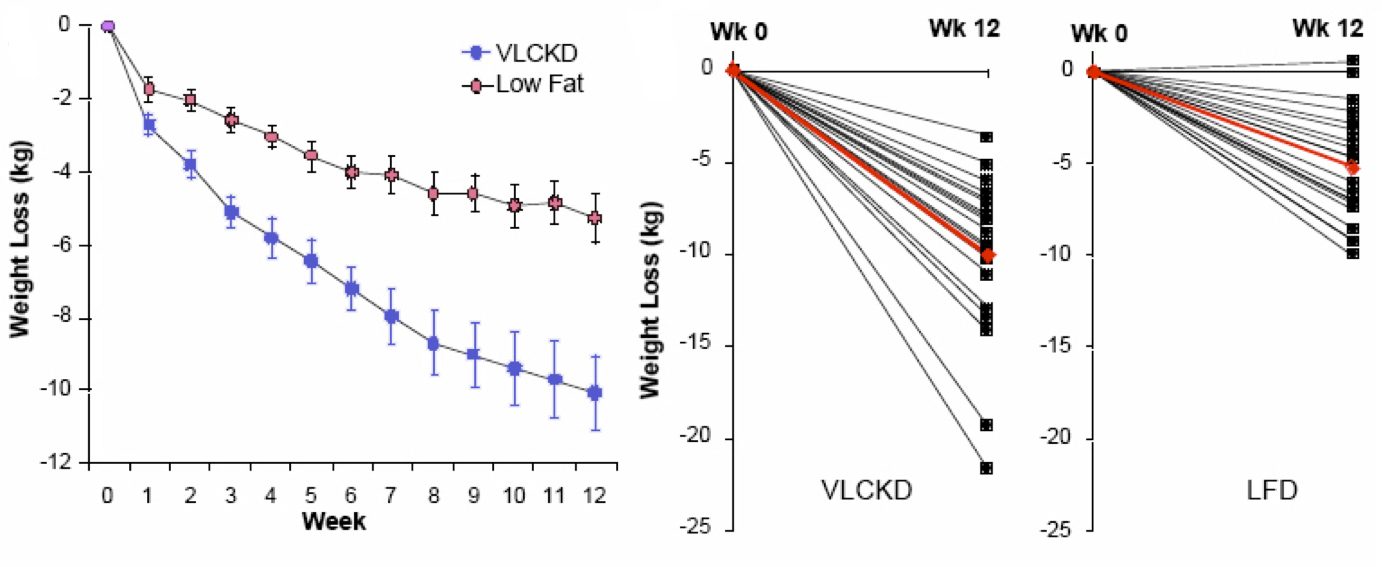
The paper is one of the more striking for the differences in weight loss between two diet regimens. Although participants were not specifically counseled to reduce calories, there was a reduction in total caloric intake in both two groups. The response in weight loss, however, due to the difference in macronutrient composition, was dramatically different in the two groups. The CRD group (labelled as very low carbohydrate ketogenic diet (VLCKD) in the figure) lost twice as much weight on average as the low-fat controls despite the similar caloric intake. Although there was substantial individual variation, 9 of 20 subjects in the CRD (VLCKD) group lost 10% of their starting weight. more than that lost by any of the subjects in the LFD group. In fact, nobody following the LFD lost as much weight as the average for the low-carbohydrate group and, unlike George Bray’s demonstration of caloric inefficiency, whole body fat mass was where the major differences between the CRD (VLCKD) and LF appeared (5.7 kg vs 3.7 kg). Of significance is the observation that fat mass in the abdominal region decreased more in subjects on the CRD than in subjects following the LFD (-828 g vs -506 g). This is one of the more dramatic effects of carbohydrate restriction on weight loss but many have preceded it and these have been frequently criticized for increasing the amount of saturated fat (whether or not any particular study actually increased saturated fat). Although the original “concern” was that this would lead to increased plasma cholesterol, eventually saturated fat became a generalized villain and, insofar as any science was involved, the effects of plasma saturated fat were assumed to be due to dietary saturated fat. The outcome of Volek’s study was surprising. Surprising because the effect was so clear cut (no statistics needed) and because an underlying mechanism could explain the results.

Saturated Fat
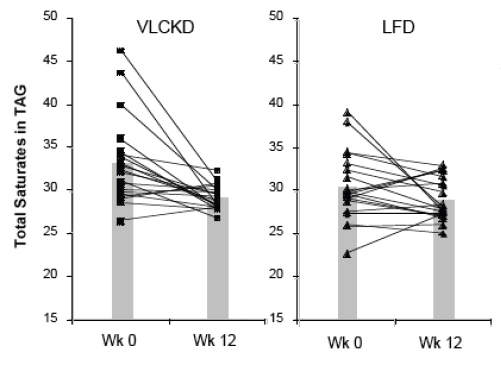
The dietary intake of saturated fat for the people on the VLCKD (36 g/day) was threefold higher than that of the people on the LFD (12 g/day). When the relative proportions of circulating SFAs in the triglyceride and cholesterol ester fractions were determined, they were actually lower in the low carb group. Seventeen of 20 subjects on the CRD (VLCKD) showed a decrease in total saturates (the others had low values at baseline) in comparison to half of the subjects consuming the LFD had a decrease in saturates. When the absolute fasting TAG levels are taken into account (low carbohydrate diets reliably reduce TAB=G), the absolute concentration of total saturates in plasma TAG was reduced by 57% in the low carbohydrate arm compared to 24% reduction in the low fat arm who had, in fact, reduced their saturated fat intake. One of the saturated fatty acids of greatest interest was palmitic acid or, in chemical short-hand, 16:0 (16 means that there are 16 carbons and 0 means there are no double bonds, that is, no unsaturation).

So how could this happen? The low fat group reduced their SFA intake by one-third, yet had more SFA in their blood than the low-carbohydrate group who had actually increased intake. Well, we need to look at the next thing in metabolism.

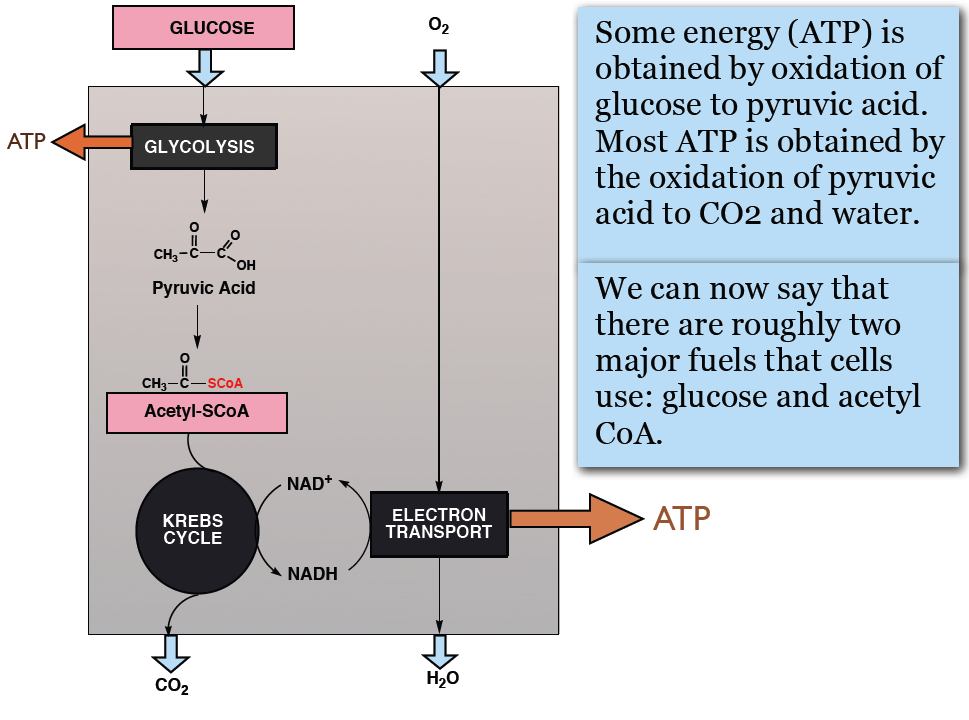
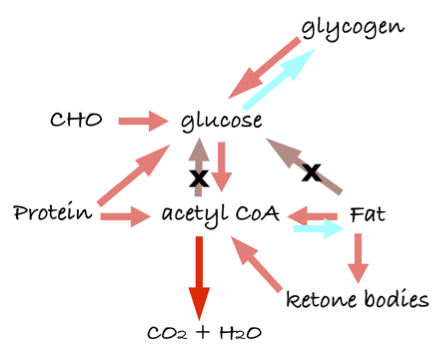
In the post on An Introduction to Metabolism, we made the generalization that there were roughly two kinds of fuel, glucose and acetyl-CoA (the two carbon derivative of acetic acid). The big principle in metabolism was that you could make acetyl-CoA from glucose, but (with some exceptions) you couldn’t make glucose from acetyl-CoA, or more generally, you can make fat from glucose but you can’t make glucose from fat. How do you make fat from glucose? Part of the picture is making new fatty acids, the process known as De Novo Lipogenesis (DNL) or more accurately de novo fatty acid synthesis. The mechanism then involves successively patching together two carbon acetyl-CoA units until you reach the chain length of 16 carbons, palmitic acid. The first step is formation of a three carbon compound, malonyl-CoA, a process which is under the control of insulin. Malonyl-CoA starts the process of DNL but simultaneously prevents oxidation of any fatty acid since, if you are making it, you don’t want to burn it. This can be further processed, among other things, can be elongated to stearic acid (18:0). So this is a reasonable explanation for the increased saturated fatty acid in the low-fat group: the higher carbohydrate diet has higher insulin levels on average, encouraging diversion of calories into fatty acid synthesis and repressing oxidation. How could this be tested?

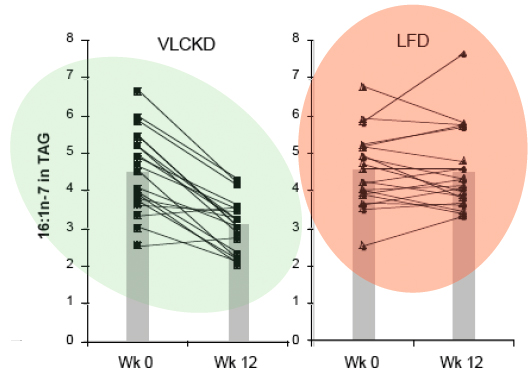
It turns out that, in addition to elongation, the palmitic acid can be desaturated to make the unsaturated fatty acid, palmitoleic acid (16:1-n7, 16 carbons, one unsaturation at carbon 7) and the same enzyme that catalyzes this reaction will convert stearic acid (18:0) to the unsaturated fatty acid oleic acid (18:1n-7). The enzyme is named for the second reaction stearoyl desaturase-1 (SCD-1; medical students always hate seeing a “-1” since they know 2 and 3 may will have to be learned although, in this case, they are less important). SCD-1 is a membrane-bound enzyme and it seems that it is not swimming around the cell looking for fatty acids but is, rather, closely tied to DNL, that is, it preferentially de-saturates newly formed palmitic acid to palmitoleic acid.

There is very little palmitoleic acid in the diet so its presence in the blood is an indication of SCD-1 activity. The data show a 31% decrease in palmitoleic acid (16:1n-7) in the blood of subjects on the low-carb arm with little overall change in the average response in the low fat group. Saturated fat, in your blood or on your plate?

Forsythe’s paper extended the work by putting men on two different weight-maintaining low-carbohydrate diets for 6 weeks. One of the diets was designed to be high in SFA (high in dairy fat and eggs), and the other, was designed to be higher in unsaturated fat from both polyunsaturated (PUFA) and monounsaturated (MUFA) fatty acids (high in fish, nuts, omega-3 enriched eggs, and olive oil). The relative percentages of SFA:MUFA: PUFA were, for the SFA-carbohydrate-restricted diet, 31: 21:5, and for the UFA diet, 17:25:15. The results showed that the major changes in plasma SFA and MUFA were in the plasma TAG fraction although probably much less than might be expected given the nearly two-fold difference in dietary saturated fat and, as the authors point out: “the most striking finding was the lack of association between dietary SFA intake and plasma SFA concentrations.”

So although it is widely said that the type of fat is more important than the amount, the type is not particularly important. But, what about the amount? A widely cited paper by Raatz, et al. suggested, as indicated by the title, that ‘‘Total fat intake modifies plasma fatty acid composition in humans”, but the data in the paper shows that differences between high fat and low fat were in fact minimal (figure below).

The bottom line is that distribution of types of fatty acid in plasma is more dependent on the level of carbohydrate then the level or type of fat. Volek and Forsythe give you a good reason to focus on the carbohydrate content of your diet. What about the type of carbohydrate? In other words, is glycemic index important? Is fructose as bad as they say? We will look at that in a future post in which I will conclude that no change in the type of carbohydrate will ever have the same kind of effect as replacing carbohydrate across the board with fat. I’ll prove it.

====================================================================

Answers to the organic quiz.
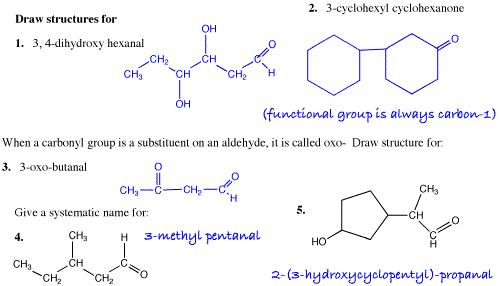
Last post, we were running with the name game, which emphasizes one of the two features of organic chemistry, its precision and logic.  The other distinguishing feature, as in all chemistry, is the sense of cooking and transformation that  we only hinted at: we had only one group of compounds, the alcohols but we did predict that the more the structure looks like water (the greater the percentage contributed by the OH group) the more water-soluble the compound was.

The last post finished with a quiz, for which I will now provide answers.  If you already know the answers and want to see new stuff, you can jump ahead.

Answers

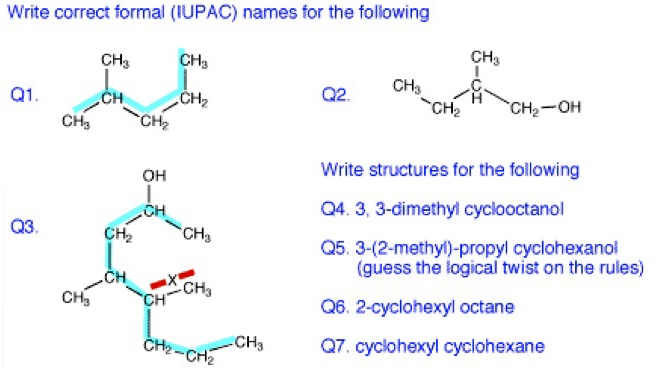
Q1. The rule: find the longest continuous chain of carbon atoms, five in this case.  Consider as if it were derived from the five-carbon hydrocarbon, pentane. (“As if” because the real compound may not have been derived from pentane). Look for substituents (attached to the main chain.  There is a one carbon substituent, that is, a methyl group. Which carbon is it attached to? Count the carbons, trying each end. Use the one with the lowest number : 2-methyl pentane (not 4-methyl pentane). The compound is an isomer of hexane but the name is unambiguous which is the idea.

Q2. Same rule.  Find the longest carbon chain. Four carbons = butane. Find the functional group, alcohol. Always use the lowest number so it is a 1-butanol (not 4-butanol).  One methyl groups, so this compound would be called: 2-methyl 1-butanol.

Q3. Find the longest carbon chain. Don’t be misled by how the structure is laid out on the page.  (The way it is written will be determined from the chemical context).  This is an 8-carbon compound, an octane backbone.  Find the functional group, an alcohol. Always use the lowest number so it is a 2-octanol.  The methyl groups on carbons 4 and 5 means this compound would be called: 4, 5-dimethyl 2-octanol.

Q4. The functional group (if there is only one) is always on carbon 1, so you do not have to specify that.  Note: carbon 3 is indicated twice.

Q5. The variation: propyl is the substituent on carbon 3 of the main structure, but this side chain itself has a substituent on carbon 2 (counting from the point of attachment to the main structure) so 2-methyl is the “adjective” that modifies “propyl.”

Q6, 7. Pretty much obvious variations on the standard rules.


Where we’re going.  The new functional group is the carbonyl, C=O, a group that has two chemical bonds between carbon and oxygen.

When the carbonyl group is at the 1-position, that is, at the end of the chain of carbon atoms, the compound is called an aldehyde.  When, someplace else in the chain, the compound is called a ketone.

The principle: compounds that have more than one functional group have a different classification — sometimes the properties of the compound are the sum of the properties of the functional groups and sometimes they interact to give totally new properties.

Compounds that have both a carbonyl group and an -OH group are called sugars, that is, the sugars are polyhydroxy aldehydes and ketones and are sometimes referred to as aldoses and ketoses.

Sugars and their polymers and derivatives are called carbohydrates. (Alcohol, that is, ethanol is not a carbohydrate).

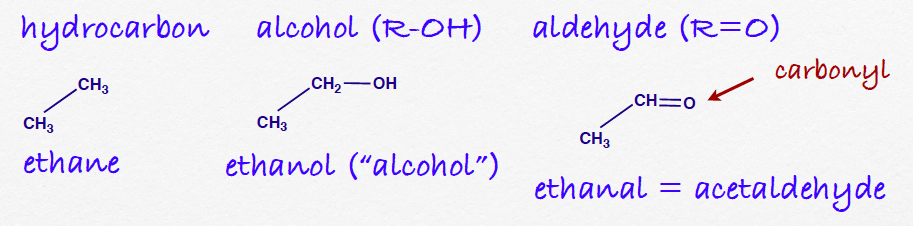
Start with aldehydes: Once again, the name game is a good idea. If you can give a correct name for the compound, then you have identified where the functional groups are and that’s where the chemistry lives.  A compound with a C=O group at one end is called an aldehyde.

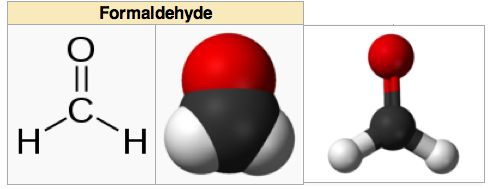
Formaldehyde.The simplest aldehyde could formally be named as if were a derivative of methane. Drop the final -e and add the suffix –al.  Methanal, however, is a very common substance and is always called formaldehyde.

Acetaldehyde. Drop the final -e from the 2-carbon hydrocarbon, ethane. Add the suffix -al.  Like formaldehyde, ethanal is a common compound, especially in biochemistry and it is always called by the familiar name acetaldehyde (accent on third syllable).  The conversion of ethanol to acetaldehyde is the first step in the liver’s processing of ingested alcohol.  Conversely, microorganisms that carry out alcoholic fermentation, convert sugar (in many steps) to acetaldehyde and then to ethanol (faites attention: you are making the transition from organic chemistry to biochemistry).  Aldehydes are chemically reactive; acetaldehyde can react with proteins of the body and is fairly toxic accounting for some of the side effects of excessive drinking.  In normal people it is cleared by the next step which incorporates the compound into metabolism; people with genetic abnormalities in metabolizing acetaldehyde (common in the Asian population) are pretty much incapable of drinking at all because of the severe physiologic responses.

The system of naming aldehydes is perfectly regular and it should be obvious how to name aldehydes of 3-carbon (propanal), 4-carbon (butanal), 5-carbon (pentanal) aldehydes, etc.  The rules for substituents are the same as before and you should be able to write the  structure of, for example, 3,3- dimethyl hexanal.

Aldehydes can be complicated and tend to have fruity or complex aromas and are, in fact, found in many natural products.  Cinnamaldehyde and citronellal smell just the way you think.  Veratraldehyde was probably first isolated from a plant called veratrum but from one of its common names, methyl-vanillin you can guess where it is used in the food industry.

If the carbonyl group appears in the middle of a chain or ring, the compound is called a ketone.  The simplest is the three carbon compound acetone; formal name would be derived by dropping the -e from propane and adding the suffix -one although this is never used.

Ketones should not be confused with the colloquial “ketones” meaning ketone bodies, the compounds produced during starvation or low-carbohydrate diets which include acetone, acetoacetic acid (a keto-acid) and β-hydroxybutyrate which does not have a keto group at all.

Sugars.

Sugars are polyhydroxy aldehydes and ketones. Organic compounds, in general, can have more than one functional group.  For names, there is a hierarchy: carbonyl compounds have precedence over alcohols.  In other words, in a compound containing both an -OH group and a carbonyl, the compound is named as an aldehyde or ketone and the hydroxyl group is treated as if it were a substituent along the lines of a methyl group as in previous exercises. The alcohol groups are called hydroxy– when a substituent in another compound.

The simplest sugars have three carbons.  The suffix -ose is common for sugars and these compounds are called trioses.  The one shown below is an aldose, or combining the classifications, it would be called an aldotriose.  The name of the common aldotriose is glyceraldehyde, a name indicating its relation to sugar but probably discovered before the “ose” terminology became common; the compound is called in German, glycerose (pr. glitzerose)

There is one ketotriose, dihydroxyacetone.

The hexoses.  Looking ahead, the major sugars of interest in biochemistry are glucose and fructose.  They are isomers (the same chemical formula) but glucose is an aldose and fructose is a ketose.  Structures are shown below but there is another level of complication, stereochemistry, that has to wait for the next organic post.

With some of the major players, however, we can start to put together some information on biochemistry.  Glycolysis: the lysis (breaking) part of glycolysis involves the cleavage of a hexose into two triodes.  Both glucose and fructose are connected throughout the triodes. Ingested fructose can be converted to derivatives of the trioses and these, in turn, can be turned into glucose.

I am currently teaching nutrition and metabolism to first year medical students.  The problem in this subject is the large number of individual reactions which leads students to think of the subject the way somebody described the study of history: just one damned thing after another.  I try to present the big picture and the approach is the systems or “black box”  strategy.  The method is to ask whether we can get some information just by looking at the inputs and outputs to a system even if we don’t know any of the details of what’s going on inside.  In other words, it is a way of organizing limited information.  The method is favored by engineers who are the people most unhappy with the idea that they don’t know anything at all.  First, the big principles.

Metabolism: two goals, two fuels.  

There are two major goals in human energy metabolism: First, to provide energy for life processes in the form of the molecule ATP and second, to provide glucose for those cells that require glucose (particularly brain and central nervous system) and to maintain blood glucose at a relatively constant level: too little is obviously not good but too much is also a problem in that glucose is chemically reactive and can interact with body material, particularly proteins when at high concentrations. Of course, metabolism does many things but these are the two major goals in providing energy.

A second big generalization is that in this process there two kinds of fuels: glucose and acetyl-Coenzyme A (abbreviated acetyl-CoA or sometimes written as acetyl-SCoA; the S, which is meant to show that the compound contains sulfur, is not pronounced).

The black box of life. 

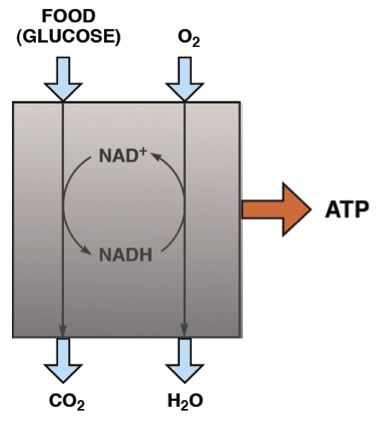
You knew what we do in metabolism even before you started reading this. Putting it into black box terms, you knew: we take in food and we take in oxygen. We excrete CO2 and water.  Somehow this gives us the energy for life as well as the material to build up components of the body.  You don’t have to know too much chemistry to figure out the important conclusion that, inside the black box, living systems use oxidation, just like combustion in a furnace. Lavoisier’s whole animal calorimeter that I described in a previous post was a beautiful real demonstration of this black box.  More technically, this is an oxidation-reduction reaction.  Oxidation, in a biochemical context, means combination with oxygen or loss of hydrogen and reduction means loss of oxygen or gain of hydrogen; we say that the (carbons in the) food gets oxidized and the oxygen gets reduced (to water).  Like the common oxidation reactions you know (combustion in a furnace or an automobile engine), this produces energy which can be used to do work. Some work is mechanical work — moving muscles — but most of the energy is used for chemical: work making body material and keeping biological structures intact and generally keeping things running.  The medium of energy in metabolism is the chemical reaction of synthesis and breakdown of the molecule ATP.  Textbooks frequently refer to ATP as a “high energy molecule” but it is not the compound itself but rather the reaction (synthesis and breakdown (hydrolysis)) that is high energy.  For the moment, we can think of ATP as the “coin of energy exchange in metabolism.”  A heavy-duty thought concept: the challenge for biochemistry historically was to explain how the energy from an oxidation-reduction reaction could be used to carry out the synthesis of ATP which has a different mechanism (phosphate transfer).  The process is called oxidative phosphorylation and was only figured out about fifty years ago.

So again, our two goals in human metabolism: Make energy in the form of ATP and maintain a pretty much constant level of blood glucose for those cells, brain and central nervous system, that require glucose (the brain can’t use fatty acids as a fuel).

Let’s look at energy production first because it is a little easier to understand.  As we look inside the black box, each of the processes uncovered will have its own degree of complexity.  In reading this you have to do what scientists do: hang in there.  Skip over the parts that seem complex and see if you can come back to them later.

The role of redox coenzymes

So, breaking into the black box, the first thing to notice is that the oxidation of food is done in steps, and that there is another player that mediates the process by coupling separate pieces: the food never sees the oxygen.  The intermediaries are called coenzymes or cofactors.  The most important oxidative coenzyme is known as NAD.  It’s always referred to by the acronym, but if you’ve had some organic chemistry and you’re curious, NAD stands for nicotinamide-adenine-dinucleotide; the structure is shown in the figure and the action end of the molecule is indicated. NAD coenzymes are derived from the vitamin niacin.  So   what happens in metabolism is that food is oxidized by NAD+ (the oxidized form of NAD) and the product, NADH (the reduced form) is re-oxidized by molecular oxygen. Although it is still just as we thought (food+oxygen-in, CO2+water-out), the oxygen never sees the food.   Why do we do it this way?  If we did it all in one big blast like an automobile engine, we would have little control over it and we would not be able to capture the energy in a usable chemical form.

It’s easiest to start with glucose, a six-carbon compound. The early steps in metabolism involve a process known as glycolysis (sugar splitting) that ultimately gives you two molecules of a three-carbon compounds known as pyruvic acid. Pyruvic acid is oxidized to a derivative of acetic acid, known as acetyl-CoA. The CoA is short for Coenzyme A, a complicated molecule but, like many coenzymes is always referred to in this way so it is not important to know the detailed structure.  The compound is frequently written acetyl-SCoA to emphasize that it is a thioester (sulfur ester); again, the “S” is not pronounced.

Acetyl-SCoA is the fuel for the major NADH-producing process, known as the Krebs cycle after the major player in its discovery. Without looking into that black box too much the key compound is citric acid, which is, chemically a try-carboxylic acid (TCA) so the Krebs cycle is also called the citric acid cycle or TCA cycle; Krebs called it the TCA cycle so I will generally use that term.  The process whereby NADH is finally re-oxidized by oxygen is known as electron transport.  So, The big black boxes of metabolism:

Where do we get Glucose and Acetyl-CoA?

So far we know: most energy comes from the oxidation of acetyl-CoA and most of the glucose that provides energy does so by first being converted to acetyl-CoA. Where else can we get acetyl-CoA? We’ve taken glucose as synonymous with food but where else can we get glucose from besides the diet?

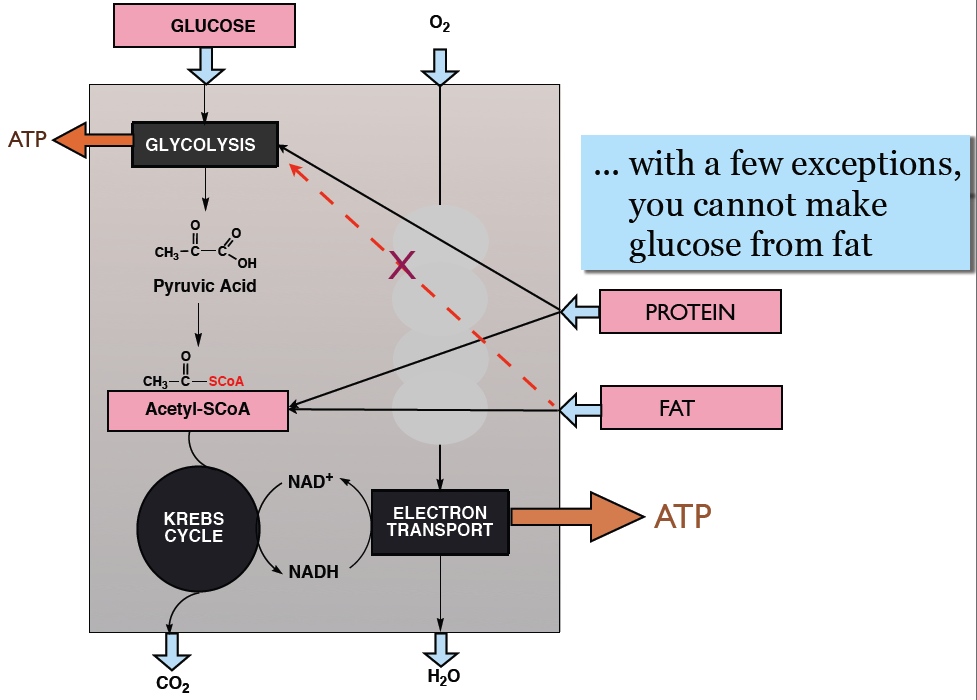
Looking ahead, the big results that will come out of opening up the black box of metabolism: 1) Acetyl-CoA also comes from fat and to a smaller extent from protein.  2) Glucose can also be formed from protein. 3) Under conditions where there is no dietary glucose (starvation, low carbohydrate diet), glucose will be made from protein or released from stored glycogen, and an alternative fuel ketone bodies will provide acetyl-CoA; ketone bodies are essentially a dimer of acetyl-CoAs and the liver makes and exports ketone bodies to other cells.  Acetyl-CoA and, therefore, glucose can be converted to fat but a major asymmetry that will have profound significance is that 4) glucose cannot be formed from acetyl-CoA.  The significance of the last statement is that: we know all too well that fat can be formed from glucose but, with minor exceptions, 5) glucose cannot be formed from fat. (Chris Masterjohn’s post “We Really Can Make Glucose From Fatty Acids After All!”
indicates the extent to which the exceptions become important but the overriding principle that has the most impact on metabolism is that you cannot make glucose from fat).
So that’s it.  You now have a blackbox view of metabolism.  I will try to open some of the boxes in future posts.

Summary of fuel sources and synthesis and looking ahead.

  1. There are, roughly speaking, two kinds of fuels: glucose and acetyl-CoA.
  2. Carbohydrates and other nutrients, fat (that is, fatty acids) and protein (amino acids) can supply acetyl-CoA.  Glucose is not required for acetyl-CoA and under conditions of low carbohydrate or low total food, fatty acids become the major source of acetyl-CoA.
  3. Not all tissues can use all fuel sources. Brain, CNS and red blood cells, for example cannot use fatty acids. Brain and CNS can use acetyl-CoA but cannot get it from fatty acids.  Red blood cells only use glucose and, to a first approximation, brain and CNS are also dependent on glucose for metabolism.
  4. Under conditions of starvation or carbohydrate restriction, acetyl-CoA can be effectively transported from the liver in the form of  ketone bodies. Ketone bodies, then, are a source of acetyl-CoA that can be used by brain and CNS.  Red blood cells are still dependent on glucose but the brain’s demand for glucose is reduced by the availability of ketone bodies.
  5. There is no dietary requirement for carbohydrate and amino acids can also supply glucose through the process of gluconeogenesis.
  6. Fat as a source of acetyl-CoA also works the other way: acetyl-CoA can be converted to fat.
  7. Whereas glucose can be converted to fat, with a few exceptions, fat cannot be converted to glucose. This will be a key idea behind carbohydrate restriction.
  8. Glucose can also be stored as the polymer glycogen.
  9. Bottom line is the limitation of “you are what you eat.” Metabolism means the interconversion of food and metabolites. Conversely, it will be critical that not everything is interconvertible. In particular, we will emphasize that you can make fat from carbohydrate but, to a large extent,  you cannot make glucose from fat.

Looking ahead on sources of blood glucose:

  1. Glucose from dietary input (referred to as the fed state; in nutrition, as the postprandial period), is depleted after about 8 hours.
  2. Glycogen is a storage/supply source of glucose.  Liver glycogen can supply export glucose to the blood, thereby supplying other tissues.  Muscle glycogen supplies glucose only for the muscle itself.  Glycogen may become largely depleted after 24 hours, depending on the conditions (exercise, for example).
  3. The third source of blood glucose is gluconeogenesis (GNG) which, as the name implies, makes glucose anew from existing metabolites. Depending on the conditions, the source of carbon may be amino acids, lactic acid or glycerol from fat metabolism.  Whereas it is sometimes indicated to be a “last ditch” source of glucose in the textbooks, it goes on all the time. The glucose it synthesizes in GNG may be used to replenish glycogen and only appear in the blood at a later time.

“Despite the claims of various diet gurus, excess calorie consumption alone and not the amount of protein in an individual’s diet contributes to the accumulation of unwanted fat….” That’s the tendentious and pretty much inaccurate first line of the press release from JAMA on George Bray’s over-feeding study “Effect of Dietary Protein Content on Weight Gain, Energy Expenditure, and Body Composition During Overeating.”  “Amount of protein?”  What’s going here?  It hasn’t really been about protein.  Most of us “diet gurus” have claimed that carbohydrate, not protein, in the diet was the key macronutrient in regulating metabolism, consistent with the basic biochemistry of the glucose-insulin axis, or as Dr. Bray described Gary Taubes’s position in a review of Good Calories, Bad Calories:

“The problem is the carbohydrates in the diet, their effect on insulin secretion, and thus the hormonal regulation of homeostasis – the entire harmonic ensemble of the human body.”

Reduction in dietary carbohydrate puts increased demands on protein for gluconeogenesis and other processes but the controlling variable is the carbohydrate. The controversy in nutrition has been largely about fat vs carbohydrate.  Should we be on a low-carbohydrate diet or a low-fat diet?

The quotation in the press release says accurately that “Earlier studies in human beings suggested that diets containing either high or low [levels of] protein are less ‘metabolically efficient’ than diets with normal protein levels.”  Accurate, but written as if metabolic efficiency had always been recognized for its importance in weight loss, as if there had not been a dispute over whether the costs of processing protein were important in energy balance, indeed, written as if Bray and coworkers had not maintained that only calories count in weight gain or loss.  The idea of metabolic advantage, that one diet could be more efficient — more weight gained/calorie — has been largely resisted by the nutritional establishment.  Is this slouching toward Metabolic Advantage? (“Who knows not [the Duke] is dead?  Who knows he is?”)

The debate is also about calories.  Should you cut calories or just cut out carbs?  Is it really “excess calorie consumption” and not the effect of excess carbohydrates ? “A calorie is a calorie” or not. Many of the gurus have gone beyond “claiming” to demonstrating that when carbohydrates are low, weight loss is greater than when carbohydrate is high and that the weight loss on a low-carbohydrate diet is primarily in fat stores rather than lean mass.  In head-to-head comparisons, for however long they are compared, low-carbohydrate diets generally out-perform low-fat diets on other parameters as well, glycemic control, the features of atherogenic dyslipidemia. This has been the major challenge to traditional nutrition and the general approach has been to simply ignore this data and dismiss the researchers with innuendo as above.

In some sense, Bray, et al. answered a question that we weren’t asking, but protein is important if more complicated than carbohydrate and fat. So what did the study find? Bray and coworkers compared three diets of 5 %, 15 % and 25 % protein at an excess of calories, that was nominally the same in each group. The study was a random controlled study and was carried out in a metabolic ward so the results are more accurate than the usual diet study that relies on dietary records.  There is something odd about this study, though, in that if you want to say that only calories are the independent variable, you can’t keep calories constant.  What was actually done was to determine the energy requirements for weight maintenance over a run-in period of 2-3 weeks on a maintenance and then an additional 40 % of calories was added.  So although the calories are constant relative to initial energy expenditure, they are not absolutely the same and this is a study of the effect of varying calories while keeping calories constant. The figure below, re-drawn from Figure 6 of the paper comparing intake of absolute energy to protein intake makes you stop and think.

When you have a small number of subjects, a single outlier can bias the results.  If you remove the single highest point (circled in red), the correlation is likely to get much weaker and the normals and low begin to separate.  In other words, the individual variation (the relative efficiency) is sufficient to make it hard to see the effect of variable energy or, perhaps, as the authors themselves set it up, it is energy normalized for baseline that is the key variable.  Then the authors are right (at least by inspection) that the protein intake does not effect the change in body fat but you have only a single value for the energy. In this case, you cannot say “calories alone account for the increase in fat” (Conclusion in Abstract) because you have only a single point.  If you keep constant the variable (carbohydrate) that is most likely to bring out differences, you shouldn’t be surprised in there are no big differences.

Even taking the conclusions at face value, the authors found, as other diet comparison studies have, that weight loss or, in this over-feeding study, weight gain, was not dependent on calories alone: “a calorie is a calorie” not.  It is likely that this was what the study was originally trying to disprove and the results must have been a disappointment.  The way out was that, in this particular case, the differential weight loss showed up in difference in lean mass, rather than in fat mass as has been found in other studies showing variable efficiency.  Since 5 % is very low protein it is probably not surprising that the diet could not provide enough protein for an increase in lean mass this group.

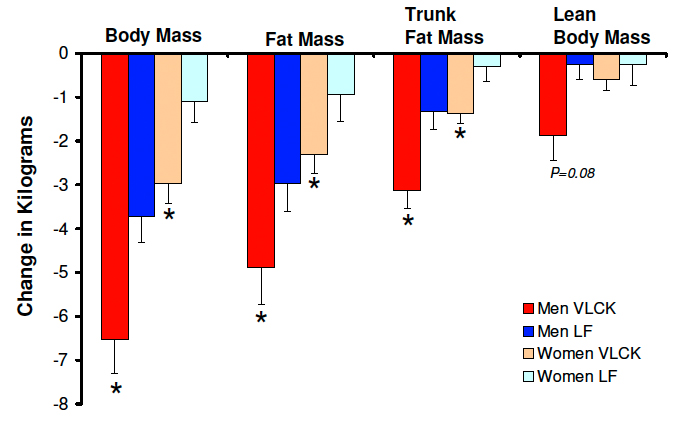
So what are the other diet studies that have found variable efficiency. The reduction in weight found in studies comparing low-carbohydrate diets and low-fat diets not only shows a difference favoring carbohydrate restriction but the improved weight loss is preferentially fat over lean mass. For example, Volek, et al. compared a low fat with a VLCK and the results are as shown below.  In their study, subjects were randomized to one of two hypocaloric diets, a very low-carbohydrate ketogenic (VLCK) diet (carbohydrate <10% of energy) or a low fat (LF) diet and after 8 weeks switched to the other diet. Reported energy was slightly higher during the VLCK but the VLCK group lost more weight and as shown below predominantly in fat, total fat loss, and trunk fat loss for men (despite significantly greater energy intake). The majority of women also responded more favorably to the VLCK diet, especially in terms of trunk fat loss the ratio of trunk fat/total fat was also significantly reduced during the VLCK diet in men and women.  These studies depend on diet recall so are less accurate than the JAMA study but because of the better experimental design, the changes are bigger and with appropriate correction make a less ambiguous case than the JAMA study. The more accurate measurements in the metabolic chamber suggest that individual variation is real and not just due to random error.

So what do we know from Bray, et al.? As described above, there is some ambiguity in what constant energy means. Still, nobody questions that under many conditions, a “calorie is a calorie,” but they actually found that weight gain was different so when metabolic advantage is “claimed” it cannot be dismissed out of hand.  This is different than widely cited studies in the literature that claim macronutrients do not effect weight loss, since if weight gain depends on macronutrient, it is reasonable that weight loss does too.  Similarly, if tissue distribution affects lean mass in this case, then studies where the tissue distribution shows preferential loss of fat can’t be dismissed — again, it is certainly not surprising that a low protein diet will lead to less storage of protein; generally, while it is just as bad a generalization as “a calorie is a calorie,” there is some truth in “you are what you eat.” Also, in the JAMA study, protein was exchanged for fat so a reduction in fat did not have an effect on fat which may or may not be a surprise to many people. Tom Naughton raised a few other questions about Bray, et al. but in the end, the paper reminds me of the joke about the Polish Mafia: they make you an offer you can’t understand.

How to do it.

But  I told George how to do it. A couple of years ago, he and I had a brief correspondence. I made the following proposal. I suggested we could apply for a joint grant and publication to get the answer.  The following is from my email to him in 2008  (I have added some highlights):

 “A modest proposal

 Proponents of carbohydrate-restricted diets (CRD) and critics of such diets cooperate to design a long-term comparison of CRD and low-fat diets.  The groups agree on methods of procedure, make-up of the diets, how compliance will be effected, and what parameters will be measured.

We write the paper first, leaving room for the data, that is, we agree in advance on what the possible outcomes are and what conclusions could be drawn from them.  The final MS can only be edited for language usage. There are no disclaimers, no Monday-morning-quarterbacking, no excuses.

The paper could be submitted while the grant application is being written and would have to be accepted because any objections could be incorporated in the plan.  The grant itself would surely be funded since it incorporates everybody’s specific aims.”

 George hasn’t answered and he obviously has a different approach to the problem but my offer still stands.

In the end, that is what it will take to solve the problem.  Unless we agree on what the question is, how it can be tested and work together to do the experiment, the lipophobes will ignore the low-carbohydrate studies and we will criticize their studies. The real losers, of course, will be the people suffering from obesity and diabetes.  The question everybody always asks me, is why can’t there be a meeting of the minds?  In the current case, why was the JAMA study done?

Why was this study done? 

 Dr Bray discussed the results with news@JAMA via e-mail.

news@JAMA: What are the practical implications of these findings for patients trying to lose weight or for the physicians trying to counsel them?

 Dr Bray: The first practical implication is an old one: calories count. We showed very clearly that the increase in body fat was due to the increased intake of calories and that the amount of protein in the diet did not change it.

 To avoid that slow weight gain that many adults experience in their middle years, people need to watch their weight and increase activity, decrease food intake, or both; changing the diet alone will not do it.”

This sounds like the the same recommendations we’ve had for years.  Writing this, I suddenly realized that, as they say in German: that’s where the dog is buried.  It is about recommendations.  This research is following the recommendations.  It used to be (should be? assume it must be?) that recommendations follow from the research. Now, it’s the other way around.  Committees make recommendations and then research (sometimes by members of the committee) tries to support the recommendations. Something about this bothers me.

The joke in academic circles is that there are three responses to a new idea. First, “This is wrong,” second, “There’s nothing new in this,” and third, the sub-title of this post. Priority in a scientific discovery is fundamental in science, however, and “we thought of this first” is not always that funny.  Getting “scooped” can have serous practical consequences like jeopardizing your grant renewal and, if nothing else, most of us are motivated by a desire to solve the problem and don’t like the feeling that, by analogy, somebody came along and filled in our crossword puzzle.  In dietary carbohydrate, all three of the responses co-exist.  While an army of dietitians is still claiming that people with diabetes need ever more carbohydrate, in the background the low-fat paradigm crumbles and, somewhat along the lines of the predictions in A Future History of Diabetes , the old guard are coming forward to tell us that they have been recommending low-carb all along.

The latest discoverer of the need to reduce dietary carbohydrate is David Jenkins whose recent paper is entitled “Nuts as a Replacement for Carbohydrates in the Diabetic Diet.” [1] The title is crazy enough, following the tradition of getting away from nutrients, that is, well-defined variables, and replacing it with “food,” that is, mixtures of everything. It is, in fact, not really a low carbohydrate study but the experimental design is not the problem.  It is the background and rationale for the study which recognizes the disintegration of the low-fat diet paradigm but, at the same time, fails to cite any of the low-carbohydrate studies that have been instrumental in showing the need to replace carbohydrates in the diabetic diet. Given forty years of studies showing the benefits of low carbohydrate diets and forty years of unrestrained attacks on the method, it will be interesting to see how Jenkins shows that it is actually the nutritional establishment that invented carbohydrate restriction.

Disputes over priority are well known in the history of science. Newton’s frequently quoted statement that he had seen farther than others because he had “stood on the shoulders of giants” has been interpreted by some historians as a sarcastic comment aimed at Robert Hooke  with whom he had, among other things, a dispute over the priority for the inverse square law (force of gravity varies as the inverse of the square of the distance: F = GmM/g2). Hooke was short and suffered from kyphosis and is assumed not to have shoulders you would profitably stand on.

Even Einstein had trouble.  His dispute with the mathematician David Hilbert about priority for the field equations of general relativity (also about gravity) is still going on, a dispute that I prefer to stay out of. Cited by his biographer, Abraham Pais, Einstein had apparently made up the  verb to nostracize (nostrazieren) which he accused Hilbert of doing. (He meant that Hilbert had made Einstein’s idea community knowledge.  Googling the word gives you only “ostracize” and “Cosa Nostra.”)

It is not the priority dispute, per se — the original low carbohydrate diet is usually attributed to William Banting who published the Letter on Corpulence in 1863, although Brillat-Savarin’s 1825 Physiologie du goût  understood the principle. He said that some people were carbophores and admitted to being one himself.  It is not just priority but that the people who are now embracing carbohydrate restriction were previously unrestrained in their attacks on the dietary approach and were adamant in denying the strategy to their patients.

David Jenkins: “Nuts.”

In trying to find an appropriate answer to the recent bit of balderdash by the redoubtable Hope Warshaw, Tom Naughton recounted the story of the Battle of the Bulge of WWII.  Towards the end of the war, Hitler launched a massive winter attack around the city of Bastogne where, at one point, American Forces were surrounded. When the Germans demanded surrender, the American General, Anthony McAuliffe, sent the one-word reply: “Nuts!”  I always thought it was a euphemism and that he actually went “Vice-presidential” as it was called in the last administration, but it turns to have been a common expression with him and he really did write “nuts” which, of course, had to be explained to the German couriers. (There is a “Nuts” Museum in Bastogne commemorating the battle which the Americans won somewhat as described in the movie Patton).

For installation in the Nutritional Nuts Museum and as an example of the current attempts to co-opt carbohydrate restriction, one can hardly beat Jenkins’s recent paper [1].

Richard:…Who knows not that the gentle duke is dead? ….

King Edward: Who knows not he is dead! Who knows he is?

Queen Elizabeth: All-seeing heaven, what a world is this!

— William Shakespeare, Richard III

The trick is to act as if the point you are making is already established. The Abstract of Jenkins study: “Fat intake, especially monounsaturated fatty acid (MUFA), has been liberalized in diabetic diets to preserve HDL cholesterol and improve glycemic control….” It has? Liberalized by whom?  Although the American Diabetes Association guidelines are traditionally all over the place, few would consider that there is any sense of substantial liberalization on replacing carbohydrate with fat from them or any health agency.

“Replacement of carbohydrate by healthy fat … has been increasingly recognized as a possible therapeutic strategy in the treatment of diabetes [2] as concerns emerge over the impact of refined carbohydrate foods in increasing postprandial glycemia and reducing HDL cholesterol.”  Reference [2] ((1) in the original) actually “emerged” in 2002 and is ambiguous at best: “Carbohydrate and monounsaturated fat together should provide 60–70% of energy intake.” (It is not my style of humor, but the behavioral therapists call this “shoulding on people.”) The paper admits that the evidence “is based on expert consensus”  and contains what might be called the theme song of the American Diabetes Association:

 “Sucrose and sucrose-containing food do not need to be restricted by people with diabetes based on a concern about aggravating hyperglycemia. However, if sucrose is included in the food/meal plan, it should be substituted for other carbohydrate sources or, if added, be adequately covered with insulin or other glucose-lowering medication.” (my italics)

In fact, one emerging piece of evidence is Jenkins 2008 study comparing a diet high in cereal with a low glycemic index diet [3].  The glycemic index is a measure of the actual effect of dietary glucose on blood glucose.  Pioneered by Jenkins and coworkers, a low-GI diet is based on the same rationale as a low-carbohydrate diet, that glycemic and insulin fluctuations pose a metabolic risk but it emphasizes “the type of carbohydrate,” that is, it is a politically correct form of low-carbohydrate diet and as stated in the 2008 study: “We selected a high–cereal fiber diet treatment for its suggested health benefits for the comparison so that the potential value of carbohydrate foods could be emphasized equally for both high–cereal fiber and low–glycemic index interventions.” (my emphasis) The Conclusion of the 24-week study was: “In patients with type 2 diabetes, 6-month treatment with a low–glycemic index diet resulted in moderately lower HbA1c levels compared with a high–cereal fiber diet.”  The figure below shows the results for HbA1c and weight loss and just looking at the figures, the results are certainly modest enough.

By coincidence, on almost the same day, Eric Westman’s group published a study that compared a low glycemic index diet with a true low carbohydrate diet [4].  The studies were comparable in duration and number of subjects and a direct comparison shows the potential of low carbohydrate diets (NOTE: in the figure, the units for the change are those of the individual parameters; an earlier version showed this as % which was an error):


Fad_Westman_Jenkins_FigWe thought of this first.

Oddly, neither of these papers are cited in the current study by Jenkins, et al.  In fact, according to the paper, the precedents go way back:

“Recently, there has been renewed interest in reducing carbohydrate content in the diet of diabetic patients. In 1994, on the basis of emerging evidence, the American Diabetes Association first suggested the possibility of exchanging dietary carbohydrate for MUFA in dietary recommendations for type 2 diabetes). Although not all studies have shown beneficial effects of MUFAs in diabetes, general interest has persisted, especially in the context of the Mediterranean diet.”

The ADA discovered low carbohydrate diets ? Did my blogpost see it coming, or what? But wait…

 “low carbohydrate intakes have also been achieved on the Atkins diet by increasing animal fats and proteins. This influential dietary pattern is reflectedin the relatively lower pre-study carbohydrate intakes of ~ 45% in the current study rather than the 50–60% once recommended.

The researchers in this area might not feel that 45 % carbohydrate has much to do with the Atkins diet but, in any case, it appears not to have been “influential” enough to actually get the studies supporting it cited.

Again: “Fat intake, especially monounsaturated fatty acid (MUFA), has been liberalized…” but “… the exact sources have not been clearly defined. Therefore, we assessed the effect of mixed nut consumption as a source of vegetable fat on serum lipids and HbA1c in type 2 diabetes.”  Therefore? Nuts?  That’s going to clearly define the type of MUFA?  Nuts have all kinds of nutrients.  How do we know that it is the MUFA in the nuts?  In fact, the real question is whether any benefit would not be due to the reduction in carbohydrate regardless of what it were replaced with. So what was the benefit? The figure above shows the effect on hemoglobin A1C. As described by the authors:

 “The full-nut dose reduced HbA1c by two-thirds of the reduction recognized as clinically meaningful by the U.S. Food and Drug Administration (.0.3% absolute HbA1c units) in the development of antihyperglycemic drugs…”

 In other words, almost meaningful, and

 “the number of participants who achieved an HbA1c concentration of <7% (19 pre-study participants, down to 13 post-study participants) was significantly greater on the nut treatment than on the muffin treatment (20 pre-study participants, remaining at 20 post-study participants…).”

This is some kind of accomplishment but the figure above shows that, in fact, the results were pretty poor.  The statistics do show that the “full nut dose” was significantly different from the half-nut dose or the muffin.  But is this what you want to know?  After all, nobody has an average change in HbA1c.  What most of us want to know is the betting odds. If I down all those nuts, what’s the chance that I’ll get better.  How many of the people in the full-nut study did better than those in the half-nut study (did the authors not know that this would sound funny?).  You can’t tell for sure because this information is buried in the statistics but the overlap of the error bars, highlighted in pink, suggests that not everybody gained anything — in fact, some may have gotten worse.

What kind of benefit is possible in a dietary intervention for people with diabetes?  Well, the studies discussed above from Jenkins himself and from Westman show that, with a low-GI diet, it is possible to obtain an average reduction of about 4 %, more than ten times greater than with nuts and with a real low-carbohydrate diet much greater.  I have added an inset to the Figure from Jenkins with data from a 2005 study by Yancy, et al. [5].  The red line shows the progress of the mean in Yancy’s studied.  If you had diabetes, would you opt for this approach or go for the full-nut dose?

Bibliography

1. Jenkins DJ, Kendall CW, Banach MS, Srichaikul K, Vidgen E, Mitchell S, Parker T, Nishi S, Bashyam B, de Souza R et al: Nuts as a replacement for carbohydrates in the diabetic diet. Diabetes Care 2011, 34(8):1706-1711.

2. Franz MJ, Bantle JP, Beebe CA, Brunzell JD, Chiasson JL, Garg A, Holzmeister LA, Hoogwerf B, Mayer-Davis E, Mooradian AD et al: Evidence-based nutrition principles and recommendations for the treatment and prevention of diabetes and related complications. Diabetes Care 2002, 25(1):148-198.

3. Jenkins DJ, Kendall CW, McKeown-Eyssen G, Josse RG, Silverberg J, Booth GL, Vidgen E, Josse AR, Nguyen TH, Corrigan S et al: Effect of a low-glycemic index or a high-cereal fiber diet on type 2 diabetes: a randomized trial. JAMA 2008, 300(23):2742-2753.

4. Westman EC, Yancy WS, Mavropoulos JC, Marquart M, McDuffie JR: The Effect of a Low-Carbohydrate, Ketogenic Diet Versus a Low-Glycemic Index Diet on Glycemic Control in Type 2 Diabetes Mellitus. Nutr Metab (Lond) 2008, 5(36).

5. Yancy WS, Jr., Foy M, Chalecki AM, Vernon MC, Westman EC: A low-carbohydrate, ketogenic diet to treat type 2 diabetes. Nutr Metab (Lond) 2005, 2:34.

The last Organic-Biochemistry-Nutrition post presented the saturated hydrocarbons, which are familiar as gasolines and other fuels and oils.  The first step in getting control of organic chemistry is to be sure you can identify each compound which means recognizing (or assigning) a precise name.  From a theory standpoint, these compounds also provide the skeletons for nomenclature of the other classes of organic compounds.

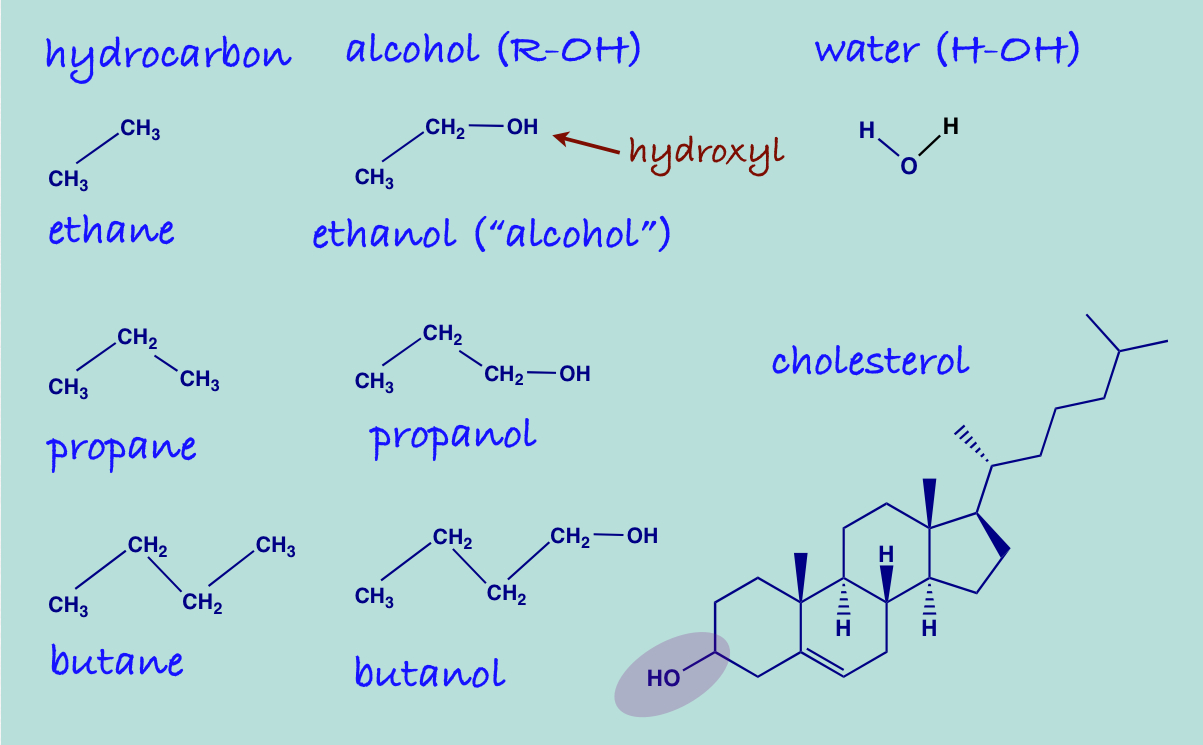
The class of alcohols are those compounds that have a saturated carbon backbone and have one or more -OH groups attached.  The simplest alcohol is methanol CH3-OH.  Others are shown in the figure from the last post which emphasized that even if the backbone got very complicated, as in cholesterol, it was still an alcohol. The greater the percentage of the molecule that is -OH rather than hydrocarbon, the more they resemble water and the more they behave like water.  So, methanol, ethanol and propanol are soluble in water whereas butanol and higher alcohols are not.  Looking ahead, however, there are other chemical properties that are common to all alcohols: this is why it is so convenient to lump them together.

I received a comment on the last post that said “One wish, though: I don’t quite understand the graphic on cholesterol and how would that look when presented as the chemical symbols like all the other molecules in that last picture.”  I suggested the following exercise for understanding it by problem-solving. If you want to try this first, here is the exercise (answers follow):

  1. Draw the molecular formula for hexane.
  2. Connect the ends of the molecule by making a carbon-carbon bond.
  3. Recognize that now you have a hexagon-shaped objects all of whose vertices are CH-2. This molecule, not-surprisingly, is called cyclohexane.
  4. Since you know that all the points are CH-2, you can save time by just drawing the geometric figure.
  5. To make sure you have the idea, draw cyclopentane.
  6. Now draw a structure with two fused rings: two hexagons sharing a common side. This structure is called decalin (because it has ten carbons).
  7. Draw a C at each vertex or intersection. Now fill in hydrogens so that every carbon has four bonds. There should be 8 CH-2 and 2 CH.
  8. You can make a complex structure with three fused hexagons and one pentagon, as in the drawing. This structure is called cholestane and is the basis of the cholesterol in the drawing.
  9. If all this makes sense, Google “cholesterol structure” and click on “Image” in the top menu bar and you’ll see different representations.

The arrow is meant to show that the hexane molecule has no rigid structure and could be folded up. The relation to cyclohexane is formal, that is, pictorial.  (It is not that easy to convert one to the other in the laboratory). This has defined a new class of compounds, the cyclic hydrocarbons, that, rather than straight chains, are arranged in cyclic structures.  Before tackling questions 8 and 9, need to look at one more basic step.

Precise Names.

The allure of organic chemistry (to those who are attracted to it) is its precision and logic.  That’s why an important feature is the name game, giving precise names to organic compounds.  The idea is that if you order something from a chemical company, you want to know exactly what you are going to get.  Thinking about butanol, now, you might ask what you would call a compound that had exactly the same composition as butanol except that the -OH group was not at the end but rather attached to one of the other carbons.  To remove ambiguity in a case like this, the carbons are numbered. There are, in fact, two butanols: 1-butanol and 2-butanol.  There is no such thing as 3-butanol because, looking at the structures and remembering that we are trying to represent something from 3-D space, there is no difference between carbon-2 and carbon-3.

The big rule for numbering organic compounds: pick a numbering system that has the lowest numbers.  Even if, for some reason, the structure is written so that the hydroxyl group appears to be at the far end, you always pick the number so that is the lowest possible.  The next figure shows you some examples.  Make sure you are happy with this system.

More on Hydrocarbons.  Branched Chains.

The unique features of carbon atoms: the ability to form four chemical bonds and to form chemical bonds with other carbon atoms to form long chains. In addition to long linear chains, carbon can also form compounds with branches. Once you have 4 carbons in a chain (butane)there is more than one way to arrange the carbons. The figure below shows different representations of a compound called iso-butane, an isomer of what we originally wrote for butane. (Isomers are compounds that have the same type and number of atoms but a different arrangement). The straight chain form could be called normal butane, or n-butane but, once there is a precise name for isobutane, n-butane will just be called butane.


So, the problem is that there are literally millions of compounds and you can’t have a name for every one. Besides, chemists don’t really like to memorize things and pretty much feel that learning the names of the ten straight chain hydrocarbons should be enough and there must be a logical system for naming organic compounds by relating them to the simpler ones.

The Systematic Name Game.

The system in organic (called the IUPAC system after the International Union of Pure and Applied Chemists) starts from the straight chain hydrocarbons. Every compound is named as if it were derived from one of those.  To name a compound, then, find the longest possible continuous straight chain of carbon atoms.  For isobutane, this would be 3, that is propane.  What about the extra carbon atom?  That is assumed to come from a hydrocarbon too but is considered a substituent (substituting for a hydrogen atom), that is, an “add-on” and is given an adjective name “methyl,” and so a systematic name for isobutane is methyl-propane.  Similarly, there are two isomers for the 5-carbon hydrocarbon: pentane and methyl-butane.  For the 6-carbon compounds vatiation, methyl-pentane, there are two different isomers. Using the rule from the alcohols, the two must be called 2-methyl pentane (never  4-methylpentane) and 3-methylpentane. The examples at the end of this post should allow you to learn how to play the game.  A couple of questions are included.  Answers will be in the comments and the structures in the next post.  To find out what kind of substance they represent, for the simpler ones like isobutane, you can Google them but you should have a sense of power that you can give the precise chemical name for a large number of chemicals. First, two more rules.

Hydrocarbon names and substituent names.

Substituents can have more than 1 carbon (although obviously not more than the main chain to which they are attached. Why not?)

More than one substituent gets more than one number.

If there is more than one substituent, you use the prefix di-, tri-, tetra-, penta-, hexa- and indicate all numbers, even if they fall on the same carbon.  You should be able to follow the examples and you should be able to do the questions.

External links

For more information or to reinforce what you have here: Drawing organic molecules and Organic structures sites as well as Quiz on naming organic compounds.  Also, good intro as part of heavy-duty organic text (skip parts that are complicated).

Finally, cholestane

The hydrocarbon chains (and branches) can sometimes be written, like the cyclic hydrocarbons, just showing the geometry.  Recall the 3-D convention: a wedge represents atom coming out of the screen and a dotted line, an atom behind the plane of the screen.  Here it is.  Cholestane is the basic structure.  Cholesterol is an alcohol derivative as above.

The themes in my blog are the scientific issues in nutrition, how to interpret data in the literature and my take on policy issues like taxing fat and taxing sugar.  The most important thing, though, is the basic science because you really can’t understand nutrition without biochemistry and you really can’t do biochemistry without organic chemistry. Organic chemistry refers to the chemistry of carbon compounds. The term once referred to the chemistry of living organisms but now would includes polyethylene as much as fructose and, in the extreme case, the plastic bottles made from corn. I am going to try to present the science and I will start from scratch and make it very elementary. My experience is that chemists don’t mind very elementary — at professional seminars, it is the Nobel prize winner who asks the really simple question (because he doesn’t care what you think of him, he just wants to know the answer). I am interested in reader feedback as to whether this is what you want to know and if this and subsequent blogs help.

The good news is that, contrary to the college myth, organic chemistry is easy.  It is freshman chemistry that is hard (because it depends more on physical chemistry, that is, physics), so I think I can get you up to speed on biochemistry and nutrition pretty fast. I am duplicating some of the material on my YouTube presentation but people told me that that is not always the best format.  So, organic chemistry is easy. That’s the first thing.

The second thing is that chemistry is  structural, that is, visual and what a chemist sees in chemical formulas is visual objects.  I am going to show what a chemist is thinking about in dealing with chemical formulas.  It’s graphic, so I will try to use as few words as possible. Comments on the figures at the end of the post.


Start with H2O

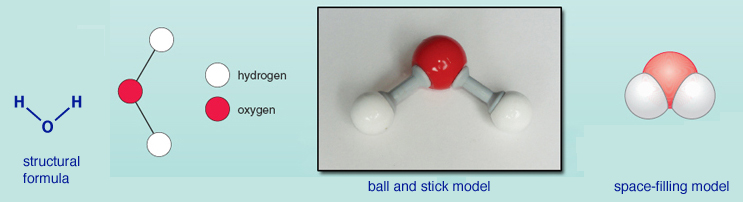
What a chemist sees in the formula H2O is a diagram, or structural formula. What a chemist thinks of when they see that diagram is the ball and stick model  or maybe the so-called space-filling model which is supposed to be closer to what you would see if it weren’t that molecules of water  are too small to be seen.

Methane is the simplest organic compound – The formula is CH4 – carbon always forms 4 chemical bonds. Different views of methane below. Methane is a colorless, odorless gas, the major component of natural gas (the odor of cooking gas comes from an added compound as a safety warning). Various representations below. (The wedge (coming out of the paper) and dotted line (behind the plane of the paper) is a shorthand representation of the 3D structure

Carbon Forms bonds with Other Carbons and Carbon Atoms Can Form Chains – Think of two methane molecules tied together by replacing one of the carbon-hydrogen bonds in each with a carbon-carbon chemical bond.  The two carbon compound (C2H6) is called ethane. We can, similarly build up chains of carbon atoms. which will be the skeletons on which millions of organic compounds will be constructed.  Carbon always forms four chemical bonds.  A compound that has only carbon and hydrogen is called a hydrocarbon.  The series built up from ethane are called saturated hydrocarbons (other name: alkanes) meaning that they have as many hydrogens as possible.

There is a Family of Organic Compounds – everything is organized as if it came from the chain of carbons known as saturated hydrocarbons.  (IUPAC is the International Union of Pure and Applied Chemists who standardizes chemical names).  Propane is a gas but it can be compressed into a liquid and is used as a fuel for various kinds of engines or for barbecues or welding torches. The higher hydrocarbons are fuels; you recognize the name octane as a component of gasoline which is a mixture of the higher saturated hydrocarbons. Much larger hydrocarbons are the major constituent in industrial and motor oils. The first ten hydrocarbons are shown in this table:


STOP.  Are you with me so far? If so, you should commit to memory the names of the ten hydrocarbons.  Everything else depends on this.  Most organic compounds are given names based on this system.

The Secret of Organic Chemistry: Functional Groups

Organic compounds have two parts: a hydrocarbon backbone and a functional group, the non-hydrocarbon part that contains the chemically reactive part of the molecule, the functional groups. The assumption is that all compounds with the same functional group have similar chemistry. The millions of organic compounds are grouped into classes: alcohols, aldehydes, acids, sugars, amino acids, etc. based on which functional groups they contain. It’s easiest to understand by example.  Look at the alcohols.

What Alcohols Look Like

Start with the simplest functional group. The combination of oxygen and hydrogen as a functional group is called hydroxyl.  Any compound that has an hydroxyl group is called an alcohol.  The common term “alcohol” refers to ethanol, one specific type of chemical alcohol.  The simplest series of alcohols are those derived from the saturated hydrocarbons.  If the hydroxyl group is added at the end of the chain, the compound is called a primary alcohol.  To name such compounds, you count the number of carbons, use the name from the hydrocarbon, e.g., ethane and remove the “-e” at the end and add “-ol.”   The figure below shows you that no matter how complicated the hydrocarbon backbone, if there is an OH group, the compound is an alcohol.  Cholesterol is an alcohol (you can figure out that if you know that a structure has only CH groups, they can be indicated just with the geometry without writing the symbols, each vertex in the figure representing one carbon atom).

Next chemistry post:

Aldehydes, sugars and sugar alcohols.

Do I get it?  Answers in the comments.

  1. Can you write the structural formula for octanol?
  2. When there is more than one hydroxyl group, the number of groups may be indicated by “di-, tri-” etc. The common compound glycerol would be called propane triol.  What does it look like?

I thought that, for a change of pace, I would take a Mediterranean perspective.  The Mediterranean Diet is widely considered as an ideal diet since it is not explicitly low-fat (most of the time) while still allowing people to avoid saying low-carbohydrate which is not fashionable in many circles.  At the end of this post, however, I have included a couple of recipes from Judy Barnes Baker’s new cookbook, Nourished; a Cookbook for Health, Weight Loss, and Metabolic Balance.  For general health, Mediterranean diets have the advantage that nobody is really sure what they are and hence there are no long term trials of the type that makes low-fat diets look so bad, as in the Women’s Health Initiative.

Tournedos Rossini

Start with Giochino Rossini.  It is generally known that his life as a composer included significant time for food. He retired in his forties and devoted the rest of his life to cooking and eating. (William Tell was his last opera). Rossini said that he had only cried twice as an adult. The first time was when he heard Paganini play the violin and the second, when a truffled turkey fell in the water at a boating party.


Because his later life was more or less in seclusion, there is some confusion about his gastronomic experiences.  It is not even clear whether Tournedos Rossini was made for him or by him.  In fact it is not even clear where the name Tournedos comes from.  Derived from tourner en dos, turning to the back, it may refer to the method of cooking or possibly that somebody had to turn their back during the preparation so as not to let anyone see the secret of the final sauce.  The recipe, although simple in outline, has expensive ingredients and the final sauce will determine the quality of the chef. It simply involves frying a steak and then putting a slab of pate de foie gras with truffles on top. The sauce is based on a beef reduction. More at Global Gourmet.

  1. Sauté the 4 center-cut filets mignons, chain muscle removed, 6 ounces in the 2 tablespoons (30 milliliters) clarified butter or vegetable oil on both sides until rare.
  2. Remove excess fat with with paper towel and place on heated plates.
  3. Place warm pate de foie gras slices on each tournedo.
  4. Cover with Périgueux Sauce:

Bring 1-1/2 cups (375 milliliters) of demi-glace to slow simmer. Add 5 tablespoons (75 milliliters) of truffle essence and 2 ounces (50 grams) of either chopped or sliced truffles. Off heat and cover with tight-fitting lid, allow truffles to infuse into the sauce for at least 15 minutes. (The sauce using truffles sliced into shapes rather than pieces is called Périgourdine).

5. Finish with a little truffle butter.

Lardo di Colonnata

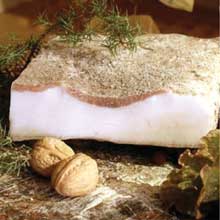
Not really a make-at-home item, this traditional creation from Tuscany captures the care in processing  that makes Italian food famous.  The original curing method supposedly goes back to the year 1000, and has been handed down from generation to generation.  The lard, of course, comes from pigs that have not undergone the genetic transformation that American pigs have.  In any case, you will need marble tubs which you should keep in the basement assuming that there are no caves in your neighborhood.  You rub the tubs with garlic and then layer the pork lard and cover with brine, add sea salt and spices and herbs. You continue with additional layers until the tub is full and then cover with a wooden lid. Curing time is about 6 to 10 months.

Greek Barbecue

As described on one of the Greek food sites “anyone visiting Greece would wonder exactly what is meant by the Mediterranean diet for while those of us outside the Med have been eating more whole grains, extra virgin olive oil and fresh vegetables…. as the Greeks become more affluent they eat more meat.” I haven’t been in Greece for many years but I remember quite a bit of meat then. Of course, in Greece, as elsewhere, affluence is a sometime thing but the trend is for festive holiday foods to be increasingly available all year round.  The most popular food for Easter is whole lamb roasted on a spit  The recipe is simple, if not convenient for the small family “You will need 1 whole lamb, skinned and gutted…”  Seasoning can be simple salt and pepper or basted with ladolemono, mixture of lemon juice, olive oil and oregano.

As the site points out, Lamb on the spit “is especially popular [at Easter] because it follows 40 days of fasting for lent and people are definitely ready for some meat, though not everyone fasts the entire forty days.” This reminds me of little known angle on the Seven Countries study.

Ancel Keys auf Naxos

The idea of a Mediterranean diet derives, in some way, from Ancel Keys’s Seven Countries study. He discovered that the two countries with the highest consumption of fat, had the lowest incidence of cardiovascular disease (Crete) and the highest (Finland), and he attributed this to the type of fat, olive oil for Crete and animal fat for Finland.  It was later pointed out that there were large differences in CVD between different areas of Finland that had the same diet.  This information was ignored by Keys who was also a pioneer in this approach to conflicting data.  Another of the rarely cited responses to the Seven Countries study was a letter written by Katerina Sarri and Anthony Kafatos of the University of Crete and published in the journal Public Health Nutrition: 8(6), 666 (2005):

“In the December 2004 issue of your journal…Geoffrey Cannon referred to … the fact that Keys and his colleagues seemed to have ignored the possibility that Greek Orthodox Christian fasting practices could have influenced the dietary habits of male Cretans in the 1960s. For this reason, we had a personal communication with Professor Christos Aravanis, who was responsible for carrying out and following up the Seven Countries Study in Greece. Professor Aravanis confirmed that, in the 1960s, 60% of the study participants were fasting during the 40 days of Lent, and strictly followed all fasting periods of the church according to the Greek Orthodox Church dietary doctrines. These mainly prescribe the periodic abstention from meat, fish, dairy products, eggs and cheese, as well as abstention from olive oil consumption on certain Wednesdays and Fridays….”

“this was not noted in the study, and no attempt was made to differentiate between fasters and non-fasters. In our view this was a remarkable and troublesome omission.”

Kokoretsi.

Leopold Bloom ate with relish the inner organs of beasts and fowls. He liked thick giblet soup, nutty gizzards, a stuffed roast heart, liver slices fried with crustcrumbs, fried hencod’s roes. Most of all he liked grilled mutton kidneys which gave to his palate a fine tang of faintly scented urine.

— James Joyce, Ulysses.

Along with Greek Barbecue, it is traditional at Easter to serve kokoretsi which is  made from the internal organs of the lamb. Liver, spleen, heart, glands are threaded onto skewers along with  the fatty membrane from the lamb intestines. When the skewer is full, the lamb intestines are wrapped around the whole creation. It is then barbecued over low heat for about 3-5 hours.


One of the regrettable aspects of the decline in food quality in the United States is the general disappearance of organ meats although the Paleo movement may help with this.  Organ meats were once very popular; the quotation above is probably the second most widely quoted passage from James Joyce’s Ulysses. Because of various ethnic influences, they were probably more popular in New York than in America (which begins somewhere in New Jersey).  I found Jimmy Moore’s confrontation with beef tongue  quite remarkable in that (in its corned form (like corned beef)), tongue was once a staple of my diet.  When I was in grade school, there were many weeks where I would bring tongue sandwiches on Silvercup bread for lunch every day.  Silvercup, made in Queens was the New York version of Wonder Bread. The Silvercup sign is still a fixture of the New York landscape — it is now the site of Silvercup Studios, the major film and television production company that kept the name (and the sign) when the Bakery folded and the studio bought the building in 1983. (You name the TV show, it was probably produced at Silvercup).

Of course, everybody draws the line somewhere. Although I used to eat with my friends at Puglia, the Little Italy restaurant that specialized in whole sheep’s head, I passed on this delicacy mostly because of the eyeballs.  Also, although you gotta’ love the euphemism Rocky Mountain Oysters, bull testicles don’t do it for me, at least if I know for sure in advance. (I don’t really mind, in retrospect, if the folk-myths about the tacos that I ate outside the bullring in Mexico City were really true).

Etymology of Food Words

Whether it is the steak or the cook whose back is turned in Tournedos, it is generally difficult to find the etymology of food words, although some are obvious. The conversion of Welsh Rabbit to Welsh Rarebit is surely an attempt to be more politically correct and avoid Welsh profiling.  One disagreement that I remember from way back when I was in college is now settled. There used to be many ideas about the origin of the word pumpernickel.  One of my favorites at the time was that Napoleon had said that it was “pain pour Nicole” (his horse). Great but not true, it is now agreed that it comes from the German, pampern, to fart and Nickel meaning goblin, along the lines of Saint Nick for Santa Claus.  So pumpernickel means Devil’s Fart presumably due to the effect of the unprocessed grain that gives it its earthy quality.  Which reminds me of the ADA’s take on fiber that I quoted in an earlier post: “it is important that you increase your fiber intake gradually, to prevent stomach irritation, and that you increase your intake of water and other liquids, to prevent constipation.”  foods with fiber “have a wealth of nutrition, containing many important vitamins and minerals.” In fact, fiber “may contain nutrients that haven’t even been discovered yet!” (their exclamation point).

In Brooklyn, the Mediterranean diet means Italian sausage, largely from Southern Italy.  I had always assumed that Soppresata (pronounced, as in Naples, without the final vowel) was so-called because it was super-saturated with fat, but I have been unable to confirm this; since first writing this post, Italian friends have suggested that it comes from Sop-pressata, that is “pressed on,” but this is also unconfirmed.  There are many varieties but supposedly the best is from Calabria.  For something like this, with so many varieties which each cook is sure is the best, there is no exact recipe, but you can get started with this from About.com Italian Food.

 6.6 pounds (3 k) of pork meat — a combination of loin and other lean cuts

1 pound (500 g) lard (a block of fat)

1 pound (500 g) pork side, the cut used to make bacon

Salt, pepper

Cloves, garlic and herbs (rosemary, lemon peel, parsley etc

1/2 cup grappa (I think you could also use brandy if you want)

The basic ideas is to remove all the gristle, and chop it with the lard and the pork side. About.com recommends a meat grinder but I suspect that the knife blade of a food processor is better.  Then, wash the casing well in vinegar, dry it thoroughly, and rub with a mixture of well ground salt and pepper. “Shake away the excess, fill the casing, pressing down so as to expel all air, close the casing, and tie the salami with string. Hang for 2-3 days in a warm place, and then for a couple of months in a cool, dry, drafty spot and the sopressata is ready.”

At exactly what moment these simple, natural ingredients turn into processed red meat is unknown.

Simple Mediterranean

I’ve included two recipes from Judy Barnes Baker’s new book, Nourished; a Cookbook for Health, Weight Loss, and Metabolic Balance.  Currently in press, publication will be announced on her website.  For very simple Mediterranean, she suggested the following from the The Silver Spoon. Translated from  Il cucchiaio d’argento, published in 1950 by Editoriale Domas, the back cover describes it as “the bible of authentic Italian cooking and Italy’s best-selling cookbook for the last fifty years.”

Eggs En Cocotte with Bacon Fat

Serves 4

4 small slices bacon fat

4 tablespoons heavy cream

4 eggs

2 tablespoons Parmesan cheese, freshly grated

 Preheat the oven to 350º, if you wish to bake the eggs. Parboil the bacon fat in boiling water for about 1 minute, then drain. Put 1 tablespoon cream and a slice of bacon fat in each of four ramekins, break an egg into each and sprinkle with the Parmesan. Place the ramekins in a roasting pan, add boiling water to come about halfway up the sides and bake for 6-8 minutes or until the egg whites are lightly set. Alternatively, place the roasting pan over low heat for 6-8 minutes. The combination of bacon fat and cream—a strong savory taste and a milder flavor—gives the eggs a very delicate flavor.

Recipes from: Nourished; a Cookbook for Health, Weight Loss, and Metabolic Balance  (Judy Barnes Baker is the author although I and others are mistakenly listed by Amazon as co-authors).

Καλή όρεξη

Doctor:  Therein the patient must minister to himself.

Macbeth: Throw physic [medicine] to the dogs; I’ll none of it.

— William Shakespeare, Macbeth

The epidemic of diabetes, if it can be contained at all, will probably fall to the efforts of the collective voice of patients and individual dedicated physicians. The complete abdication of responsibility by the American Diabetes Association (sugar is okay if you “cover it with insulin”) and by other agencies and individual experts, and the media’s need to keep market share with each day’s meaningless new epidemiologic breakthrough leaves the problem of explanation of the disease and its treatment in the hands of  individuals.

Jeff O’Connell’s recently published Sugar Nation  provides the most compelling introduction to what diabetes really means to a patient, and the latest edition of Dr. Bernstein’s encyclopedic Diabetes Solution  is the state-of-the art treatment from the patient-turned-physician.  Although the nutritional establishment has been able to resist these individual efforts — the ADA wouldn’t even accept ads for Dr. Bernstein’s book in the early editions — practicing physicians are primarily interested in their patients and may not know or care what the expert nutritional panels say.  You can send your diabetes story to Michael Turchiano (MTurchiano.PVP@gmail.com)  and Jimmy Moore (livinlowcarbman@charter.net) at The Patient’s Voice Project.

The Patient’s Voice Project

The Patient’s Voice Project, which began soliciting input on Friday, is a research study whose results will be presented at the Office of Research Integrity (ORI) conference on Quest for Research Excellence, March 15-16 in Washington, D.C. The conference was originally scheduled for the end of August but there was a conflict with Hurricane Irene.

The Patients Voice Project is an outgrowth of the scheduled talk “Vox Populi,” the text for which is at the end of this post.  A major stimulus was also our previous study on the Active Low-Carber Forums, an online support group. The March conference will present a session on “Crisis in Nutrition” that will include the results of the Patient’s Voice Project.

Official Notice from the Scientific Coordinator, Michael Turchiano

The Patient’s Voice Project is an effort to collect first hand accounts of the experience of people with diabetes (type 1 and type 2) with different diets.  If you are a person with diabetes and would be willing to share your experiences with diet as a therapy for diabetes, please send information to Michael Turchiano (MTurchiano.PVP@gmail.com) and a copy to Jimmy Moore (livinlowcarbman@charter.net). Please include details of your diets and duration and whether you are willing to be cited by name in any publication.

It is important to point out that, whereas we think that the benefits of carbohydrate restriction have been greatly under-appreciated and under-recommended, the goal is to find out about people’s experiences:both benefits and limitations of different diets. If you have not had good success with low-carbohydrate diets, it is equally important to share these experiences.

  • Indicate if you saw a physician or other health provider, what their attitudes were and whether you would be willing to share medical records.
  • We are particularly interested in people who have switched diets and had different outcomes.
  • Include any relevant laboratory or medical results that you think are relevant but we are primarily interested in your personal reactions to different diets and interaction with physicians and other health providers.
  • Finally, please indicate what factors influenced your choices (physician or nutritionist recommendations, information on popular diets(?) or scientific publications).

Thanks for your help.  The Patient’s Voice Project will analyze and publish conclusions in popular and scientific journals.

The Survey of the Active Low-Carber Forums

The Active Low-Carber Forums (ALCF) is an on-line support group that was started in 2000.  At the time of our survey (2006), it had 86,000 members and currently has more than 130,000.  Our original survey asked members of the forum to complete a 27-item questionnaire and to provide a narrative on any other health issues.  Some of the narrative answers included in the published paper were as follows:

“I no longer have diabetes, high blood pressure, sleep apnea, joint pain, back pain and loss of energy.”

“I started low carbing for diabetes. My 3 month blood sugar was 8.9 when diagnosed. It is now 5.4. My doctor is thrilled with my diabetes control and as a side benefit, I lost all that weight!”

 “I’m controlling my diabetes without meds or injecting insulin (with an a1c below 5), my lipid profile has improved, I’ve lost weight, I’ve gained both strength and endurance, and I’ve been able to discontinue one of my blood pressure meds.”

 “I have much more energy, fewer colds or other health problems. I was able to go completely off oral diabetes medication.”

The survey covered a number of topics.  We found that most respondents had the perception that they ate less food than before their low-carb diet, and most felt that the major change in their diet was a large increase in the consumption of green vegetables and a corresponding large decrease in fruit intake.

Physicians Attitudes in the ALCF survey

The Patient’s Voice Project is likely to tell us as much about physicians, or at least their interaction with patients, as about the patients themselves. We found in the ACLF survey that slightly more than half of the people who responded said that they had consulted a physician. We were surprised that about 55 % said that the physician or other health professional was supportive of their diet. Another 30 % or so fit the category of “did not have an opinion but was encouraging after seeing results.” Only 6 % of responders indicated that “they were discouraging even after I showed good results,” which may be a surprising result depending on your feeling about the rationality of doctors vs hostility to the Atkins diet.  Perusal of patients’ opinions on diabetes websites, however, suggests that the story on people with diabetes will not be as encouraging. 

The Survey on Sources of Information

Given the contentious nature of the debate on diet in diabetes therapy, it is not surprising that a  group following a low-carb strategy would  not put much stock in official sources. The table below shows the breakdown on sources of information from the ALCF survey.  Of the half of respondents who said that they relied on original scientific publications, 20 % felt they had generally inadequate access (important articles were not accessible) whereas 61 % felt that access was adequate and were able to see most articles that they wanted.

Voices of Dissatisfaction.

Posts on the ALCLF itself reinforced the idea that official recommendations were not only a limited source of information but that many were perceived as misleading. Typical posts cited in the paper:

“The ‘health experts’ are telling kids and parents the wrong foods to eat. Until we start beating the ‘health experts’ the kids won’t get any better. If health care costs are soaring and type 2 diabetes and its complications, as are most of these expenses why are we not putting a ‘sin’ tax on high glycemic foods to cut consumption and help pay for these cost? Beat the ‘health experts’ – not the kids!”

 While I am not a fan of sin taxes, the dissatisfaction is clear, and…

 “Until I researched it three years ago – I thought the most important thing was low fat. So I was eating the hell out of low fat products and my health continued to get worse.”

Similarly, the recent article in Diabetes Health by Hope Warshaw  http://bit.ly/mYm2O3 with its bizarre recommendation for people with diabetes to increase their carbohydrate intake elicited a number of statements of dissatisfaction:

“Respectfully, this column is not helpful to diabetics and probably dangerous. I am going on 6 years of eating 30-35 carbs/day. My A1c has been in the “non-diabetic” range ever since I went this route and I feel better than I have in years. I am not an exception among the many folks I know who live a good life on restricted carb diets.”

“…carbohydrates are a very dangerous and should be consumed with caution and knowledge. i had awful lipids and blood sugar control on a low fat/high carb diet. now that i have switched to a lower carb diet – all my numbers are superb. and the diet is easy to follow and very satisfying!”

 Summary:

The Project is intended to bring out the patient’s perspective on diet as therapy in diabetes.  The goals are to document people’s experience in finding the right diet. In particular, we are interested in whether switching to a low-carbohydrate diet provided improvement over the recommended diet typical of the ADA. Or not.  We are looking for a narrative that can bring out how people make decisions on choosing a diet and sticking with it: the influences of physicians, the media and personal experimentation. Your diabetes story.

Text of Abstract for the Original ORI Conference

 Crisis in Nutrition: IV. Vox Populi

 Authors: Tom Naughton, Jimmy Moore, Laura Dolson

Objective: Blogs and other social media provide insights into how a growing share of the population views the current state of nutrition science and the official dietary recommendations. We ask what can be learned from online discussions among people who dispute and distrust the official recommendations.

Main points: A growing share of the population no longer trusts the dietary advice offered by private and government health agencies. They believe the supposed benefits of the low-fat, grain-based diets promoted by those agencies are not based on solid science and that benefits of low-carbohydrate diets have been deliberately squelched. The following is typical of comments the authors (whose websites draw a combined 1.5 million visitors monthly) receive daily:

 “The medical and pharmaceutical companies have no interest in us becoming healthy through nutrition. It is in their financial interest to keep us where we are so they can sell us medications.”

 Similar distrust of the government’s dietary recommendations has been expressed by doctors and academics. The following comments, left by a physician on one of the authors’ blogs, are not unusual:

 “You and Denise Minger should collaborate on a book about the shoddy analysis put out by hacks like the Dietary Guidelines Advisory Committee.”

“Sometimes I wonder if people making these statements even took a basic course in biochemistry and physiology.”

 Many patients have given up on their health care professionals and turn to Internet sites for advice they trust. This is particularly true of diabetics who find that a low-fat, high-carbohydrate diet is not helping them control their blood glucose. As one woman wrote about her experience with a diabetes center:

 “I was so frustrated, I quit going to the center for check ups.”

The data suggest a serious problem in science-community interactions which needs to be explored.

Conclusions & recommendations: Our findings document a large number of such cases pointing to the need for public hearings and or conference. The community is not well served by an establishment that refuses to address its critics from within the general population as well as health professionals.

The following question was posted on Facebook:

I had thought that free fatty acids were triglycerides. But I am reading a study that measured both. Can someone enlighten me on free fatty acids? … please.

 I think I can help.  The good news is that, contrary to the college myth, organic chemistry is easy — it is freshman chemistry that is hard because it has more physics and mathematics.  Now, jumping into lipid metabolism is a little bit of starting in the middle of things but the reason organic chemistry is easy is that it has only a few assumptions and basic principles and the basic theory, at least, is logical and you can get pretty far deducing things from simple principles, so with a few basic ideas we may have a shot. I have two YouTube videos that are short, relatively easy and might be a background.  The take home message from the videos, the one big idea in organic, is that organic compounds have two parts: A hydrocarbon backbone and a non-hydrocarbon part that contains the chemically reactive part of the molecule, the functional groups. The assumption is that all compounds with the same functional group have similar chemistry.  So, for example, all carboxylic acids have the carboxyl (-COOH) functional group. In many ways, even a simple acid like acetic acid has chemical properties that are similar to a complicated acid, like the fatty acids.  You may need the YouTube to appreciate this: chemistry is about structure, that is, it is visual.

Bottom line on fatty acids and Triglycerides

All dietary and body fats and oils are triglycerides (TG) or, more correctly, triacylglycerols (TAG).  The term “acyl” (pr. A-sill) is the adjective form of acid (i.e. There are three acids).

Fats have a roughly E-shaped structure. The arms of the E are the fatty acids and there are three of them. The fatty acids provide the real fuel in fats.  The three fatty acids are attached to the compound glycerol which is the vertical stroke of the E.  The chemical bond that attaches the fatty acid  to the glycerol is called an ester bond.  You only need to know the term ester because when the fatty acids are found alone, especially in blood, they are referred to either as free fatty acids (FFA) or, because they are no longer attached to the glycerol by the ester bonds, as non-esterified fatty acids (NEFA): FFA and NEFA are the same thing.

Metabolism: the fatty acid-TAG cycle.

The digestion of fat in the intestine involves the progressive removal of the fatty acids from the first and last position of the glycerol.  The process is called lipolysis and the enzyme that catalyzes the reaction is called a lipase. What remains is called 2-monoacylglycerol, or 2-MAG  (fatty acid still attached at the center carbon of glycerol) and  2-MAG and the free fatty acids from digestion are absorbed into the intestinal cells.  Within these cells they are re-formed into TAG which is exported together with cholesterol and other components in particles called chylomicrons.  Chylomicrons, in turn, represent one type of complex structure known as lipoproteins. The lipoproteins transport lipids and some of these are familiar, e.g., LDL (low density lipoprotein), HDL. Triglycerides in the blood are carried in these particles. So this is probably the triglycerides you read about.

These are the transporters of lipids.  TAG, in particular is brought into cells by another lipase (lipoprotein lipase or LPL) on the cell surface that removes the fatty acids.  In other words, to be absorbed the TAG is broken down into fatty acids again.  Once absorbed, the fatty acids can be oxidized for fuel or, once again can be re-synthesized, step-wise: → MAG → diacylglycerol (DAG)  → TAG.  Here’s the summary figure:

Bottom line:

Fat (TAG) is continually broken down and re-synthesized.  The breakdown process is called lipolysis and the lipolysis-synthesis cycle goes on in different places in the body but notably in fat cells.  An interesting thing about fat cells is the way they carry out the cycle. Lipolysis is a simple process but synthesis is complicated.  Speaking in energy terms, it is easy to break down nutrients. It requires energy to put them back together.  To make TAG, either the glycerol or the fatty acid has to be “activated”: so the actual reactive form is a molecule called fatty acyl-coenzyme A or fatty acyl-CoA (pr. Co-A).

Biochemical reactions almost never run by themselves even if energetically favorable but are rather controlled by catalysts, that is, enzymes.  The enzyme that catalyzes the first step in the reaction, a transferase, will not work with glycerol itself.  The enzyme requires a particular form of glycerol, glycerol-phosphate.  The special characteristic of the fat cell is that the required glycerol-phosphate cannot be made directly from glycerol as it can, for example, in the liver which also has an active fatty acid-TAG cycle.  In order to make glycerol phosphate, fat cells require glucose. In the absence of glucose, as in starvation or a low carbohydrate diet, fat synthesis is repressed.  At the same time the enzyme that catalyzes breakdown, hormone-sensitive lipase, is enhanced because it is turned on by glucagon and turned offby insulin (these are the hormones in the term “hormone-sensitive lipase”).  This was the original rationalization for the apparent advantage in a low-carbohydrate diet: without carbohydrate the adipocyte would not be able to supply glycerol-phosphate and the fatty acid-TAG cycle would go largely in one direction: breakdown to produce fatty acids and this is undoubtedly one of the major effects.

It turns out, however, that the fat cells protect stores of energy in fat by other methods. We now understand that cells run a process called glyceroneogenesis which is a truncated form of gluconeogenesis, the process whereby glucose is synthesized from other nutrients, mostly protein, that is, the process supplies an intermediate in the synthesis of glucose and this can be converted to glycerol-phosphate. Generally, especially if the diet is hypocaloric, the net effect is to break down fat and supply fatty acids as a fuel for other cells.  Fatty acids circulate in the blood bound to a protein called albumin. Under conditions where there is higher carbohydrate, however, and the fatty acids are not being used for fuel, they can stimulate insulin resistance. So, fatty acids in the blood are a good thing if you are breaking down fat to supply energy.  They are not so good if you are over-consuming energy or carbohydrates because, in the presence of insulin, they can lead to insulin resistance.

Summary: triglycerides are made of three fatty acids.  There is a continual fatty acid-TAG cycle that goes on all the time in different cells.  Triglycerides in the blood are carried in lipoprotein particles, chylomicrons, LDL, HDL.  Fatty acids in the blood are carried by the protein albumin.