Archive for the ‘The Nutrition Story’ Category

According to the Journal of the American Medical Association (JAMA), the principle of “evidence-based medicine (EBM),” arose in the 1990s [1]. It is widely invoked in the medical literature as a kind of certification that the conclusions of the author are not mere opinions but are backed up by compelling information in biomedical science.  It sounds good. Or does it? It is certainly self-serving and a little bit suspicious, somewhat like Nixon assuring us that he was not a crook.  Evidence based medicine?  What were we doing before?  How was Pasteur able to function in the absence of such an idea?  One thing to think about is that evidence is what is introduced into courts of law.  But not all evidence is admissible. A judge decides what is admissible and there are many precedents, in particular, on what constitutes scientific evidence in a legal proceeding.

EBM relies on a hierarchy of levels of evidence (e.g. Table 1) with the random controlled trial (RCT) as the highest and expert opinion as the lowest.  Recommendations from health agencies and awarding of research grants are frequently justified on conformity to EBM or at least on their placing primary importance on RCTs.

Evidence from the USDA

Early in 2011, the USDA released its 2010 Dietary Guidelines for Americans [2].  With the dates suggesting the backward-looking nature of the Guidelines, they were nonetheless based on the Report of a prestigious committee (DGAC) [3] who, in turn, made much of their reliance on a new Nutrition Evidence Library (NEL). I and my colleagues were invited to submit a critique of the Report by the journal Nutrition. The editor, Michael Meguid indicated that the journal wanted a balanced report, pros and cons.  I called Dr. Meguid:

RDF: You know, the report is not particularly balanced. I’m not sure how you write a balanced review of an unbalanced report.

MM:  You can make the critique as strong as you like as long as you carefully document everything. But what’s your main problem with the Report?

RDF: Well, it makes very strong recommendations in the face of contradictory evidence.

MM: Make that the title of your article.

So we wrote an article called “In the face of contradictory evidence: Report of the Dietary Guidelines for Americans Committee” [4]. The journal was kind enough to make it an open access article and it’s available on this blog. In the end, on titles, we were one-upped by Steven Malanga, whose article in the New York Post was called “Fed’s Food Fog.”

For sure, both the Report and the final Guidelines were the proverbial camel-like production of a committee, tedious, repetitive and stylistic dreadful.  But what about the NEL?  What about the evidence?  Style aside, wasn’t this evidence based medicine?

Where do these guidelines come from? The assumption is that evidence follows its etymologic roots, stuff that is visible, stuff that comes from the sensible and true avouch of our own eyes. In fact, it is most often applied, as in the case of the DGAC, to the most controversial and contentious subjects. Calling something evidence is not enough. So what happens in courts of law? In a court of law, a judge decides on whether the jury can hear the evidence.  Who decides admissibility of the evidence in EBM?

Conflict resolution in science.

Science is a human activity. Conflict, controversy and a resistance to new ideas are well known even in the so-called hard, that is, more mathematical, sciences, and even where there are no outside forces as there was in the case of Galileo.  In the twentieth century, conflicts do not generally impede progress for long. Especially in the physical sciences, there is usually agreement on basic assumptions and on the rules of logic, allowing ultimate acceptance of strong evidence. Competing theories may coexist and supporters of both are likely to admit that they are awaiting reconciliation.

What happens when the spontaneous process of conflict resolution in science breaks down?  What happens in conditions where scientific disagreement is strong and a majority position becomes so dominant that it controls the funding and publication of scientific work and can ignore or repress contradictory evidence and repress exposition of alternative theories.  In essence, how do we deal with a recapitulation of the case of Galileo?

There is no system to decide on the admissibility in the cases considered by EBM.   I am not the first person to point out that EBM is largely the position of experts on one side of a scientific conflict [5], the lowest level of evidence on traditional EBM scales (e.g. “Level III: Opinions of respected authorities… of the US Preventive Services Task Force Systems,” Table 1).  EBM is sustained by those who want to use its particular criteria but these have never been subjected to outside affirmation.

In this situation, where science cannot police itself, we have to look for some outside guidance.  What do the courts do?  As one would expect there, is a long and extensive history of the legal system’s  attempt to deal with what constitutes scientific evidence.  On the chance that the legal perspective may help, I will discuss some of the issues.

Frye and the need for rules.

A key decision in the history of science in the courts is Frye v. United States.  In 1923, a Federal Appeals court ruled that the opinions of experts have to be supported by a scientific community. Frye had been convicted of second-degree murder but appealed on the grounds that he had successfully passed a lie-detector test.  At that time the device was a simple blood pressure machine and an expert witness testified as to the results. The court ruled that the lie-detector test “has not yet gained such standing and scientific recognition among physiological and psychological authorities as would justify the courts in admitting expert testimony‚” affirming the judgment of the lower court.

The ruling in Frye gave rise to the idea of “general acceptance,” and, by analogy, this appears to be the main principle in the admissibility of evidence in the nutrition world.  Sufficiently well established that it could be included in a biochemistry text is the idea that “consumption of saturated fats is positively associated with high levels of total plasma cholesterol and LDL cholesterol and an increased risk of CHD”[6] Known to students as “the Lippincott Book,” Harvey and Ferrier is the best selling biochemistry book in the world and it is correct when it states “Most experts strongly advise limiting intake of saturated fats.”

Most, but not all.  A small but not insignificant minority hold otherwise and whereas they agree that dietary saturated fat may raise blood cholesterol, they can provide overwhelming evidence that it is not associated with cardiovascular disease. This has been demonstrated in almost every large trial.

The problem is described in Marcia Angell’s Science on Trial [7].  Angell explains that Frye was not without its critics ([7], page 126).  Opponents, she wrote,

“claimed somewhat improbably, that it would tend to exclude novel, far-sighted testimony by modern-day Galileos. There is no record of this happening once, let alone often.  Furthermore, even if a modern-day Galileo did not make into court at first, that fact should not stop him from prevailing in the scientific community.  Courts do not determine scientific acceptance, as implied by the argument that we need to keep our courts open to the hidden Galileos in our midst.”

But isn’t this exactly what has happened in nutrition and maybe, in general, in the medical community?  The “experts” control editorial boards, granting agencies and academic departments and are as powerful as the Catholic Church in repressing dissent.  They have prestige and, in many cases, undisputed accomplishments, but does science run on general acceptance? Does majority (of experts) rule?

One of the problems with Frye that lawyers have addressed is a question of identifying the field of academic or scientific field in which the general acceptance is to be considered.  Different disciplines hold to different standards.  In the case at hand, many ideas in nutrition would be dismissed out of hand by biochemists. Many methodologies would be considered absurd by physical scientists: Intention-to-treat is perhaps the most absurd.  It has been pointed out that the question of who is an expert might have applied to the techniques in the original Frye case, at least as it might be implemented today: “If polygraph examiners are selected as the relevant field, polygraph results would be admissible.” (http://law.jrank.org/pages/2006/Scientific-Evidence-Frye-v-United-States.html).

The epidemic of obesity and diabetes stands as a testament to the failure of the experts.  A small library can be assembled of books attacking establishment medical nutrition. Uffe Ravnskov’s classic Cholesterol Myths is updated in Ignore the Awkward. Gary Taubes’s recent Good Calories, Bad Calories is the most compelling and James Le Fanu’s Rise and Fall of Modern Medicine, the most succinct but just sitting at my desk now I can see a dozen others on the book shelf.  Surprisingly, there has been only one rebuttal, Steinberg’s Cholesterol Wars, the subject of the next post .

Table 1.  Examples of Levels of Evidence from Various Sources. 

US Preventive Services Task Force Systems for ranking evidence about the effectiveness of treatments or screening:

Level I: Evidence obtained from at least one properly designed randomized controlled trial.

Level II-1: Evidence obtained from well-designed controlled trials without randomization.

Level II-2: Evidence obtained from well-designed cohort or case-control analytic studies, preferably from more than one center or research group.

Level II-3: Evidence obtained from multiple time series with or without the intervention. Dramatic results in uncontrolled trials might also be regarded as this type of evidence.

Level III: Opinions of respected authorities, based on clinical experience, descriptive studies, or reports of expert committees.

Bibliography

1. Torpy JM, Lynm C, Glass RM: JAMA patient page. Evidence-based medicine. JAMA 2009, 301(8):900.

2. Dietary Guidelines for Americans, 2010 [http://www.dietaryguidelines.gov.]

3. US Department of Agriculture and US Department of Health and Human Services: Report of the Dietary Guidelines Advisory Committee on the dietary guidelines for Americans, 2010. June 15, 2010. In.; 2010.

4. Hite AH, Feinman RD, Guzman GE, Satin M, Schoenfeld PA, Wood RJ: In the face of contradictory evidence: report of the Dietary Guidelines for Americans Committee. Nutrition 2010, 26(10):915-924.

5. Marantz P, Bird E, Alderman M: A Call for Higher Standards of Evidence for Dietary Guidelines. Am J Prev Med 2008, 34(3):234-239.

6. Harvey R, Ferrier D: Biochemistry, 5th edn. Baltimore and Philadelphia: Lippincott Williams & Wilkins; 2011.

7. Angell M: Science on Trial. New York: W. W. Norton & Co.; 1996.
Coincidence.  My daughter Mimi’s school was debating whether chocolate milk, skim or otherwise, is really a good thing — whole milk of course is not a choice.  At the same time, her first grade class was studying states of matter, specifically solids and liquids.  According to Mimi, they learned that solids do not change shape and liquids flow.  These two topics come together in the bizarre world of the USDA Dietary Guidelines.  Whole milk, it seems, is not a choice because it may be a solid.

Stepping back, the logic of the USDA recommendations is that

1) we now know that  total dietary fat poses no risk for cardiovascular disease (CVD), but

2) saturated fat  is a risk for CVD and therefore Americans must

3) reduce total dietary fat intake and drink skim-milk or fat-reduced milk.  If you are confused about this syllogism, not to worry.  The Guidelines have made it simple. The Advisory Committee has always had a concern for the ability of the public to think.  Dr. Xavier Pi-Sunyer (pr. Pea-soon-yay), a member of the committee wrote an editorial about a scientific report that showed no difference in the effect of different diets (never mind that, in practice, what people ate was about the same, regardless of the “diet” to which they were assigned.) He suggested that it “seems unwise at this point to burden type 2 diabetes patients with trying to pick and choose among different high- and low-GI foods.”  Also, in unveiling the new Guidelines, secretary of Agriculture Tom Vilsack said that he had not read the previous versions.  So, any simplification is welcome. The Dietary Guidelines has, as one of its latest innovations, the introduction of the term SoFAS, which stands for Solid Fats and Added Sugar and was in line for a SAY! Award (Stupidest Acronym of the Year).  So, we simply have to understand what they mean by solid.

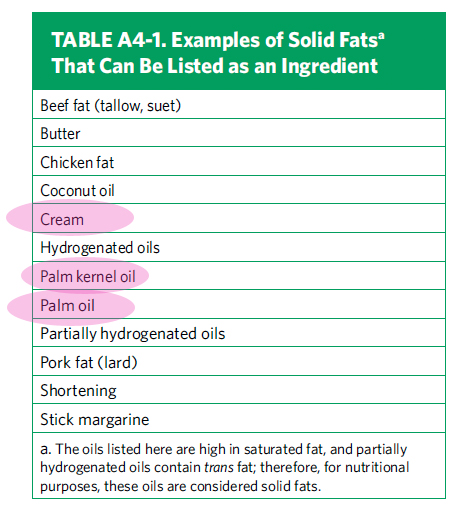
If there is anything in science that is well understood and should not be open to conjecture, it is the states of matter.  Outside of the extreme conditions that produce plasmas and other exotica, the idea of solids, liquids and gasses seems pretty much, well, solid.  It turns out, though, that since the term saturated fat is, after all, a chemical term, it is necessary to make things simple for the consumer who is now advised to look for something “solid” instead.  To do this, the DGAC explains: “To determine whether foods contain oils or solid fats, consumers can read the ingredients list to make sure that fats in the foods are oils containing primarily unsaturated fatty acids and that solid fats are not one of the first few ingredients…. Examples of solid fats that may be used in the ingredients list are provided in Table A4-1.” But, of course, labels don’t list “solid fats.”  Got it? To find out if foods contain solid fats, see if it says solid fats on the ingredient list, but since labels don’t list “solid fats” you only have to use Table A4-1 which is shown below.  The table, however, has some surprising entries.  The presence of cream and vegetable oils certainly seems a little strange.  Not to worry.  It is easy to understand if you remember that those oils “are high in saturated fat…therefore, for nutritional purposes, these oils are considered solid fats.”  In other words: when is a solid not a solid?  When the USDA says so.  Not to milk this idea too much, we have to figure out how the consumer is to deal with the fact that “fat in fluid milk also is considered to be solid fat; milk fat (butter) is solid at room temperature but is suspended in fluid milk by the process of homogenization (p. 27).”  Apparently, the simple process of distilling the fluid from milk is all that is required for the consumer to find out whether the fat is solid.

For Mimi, this is not a problem because, the fat has been reduced or removed from the milk that she is offered at school and if there is some added sugar  (8 oz. Nesquik® has 29 g.) at least we know that removal of the fat will make the milk more nutrient dense (p. 5).  In a future post, I will explain how removing nutrients can make food more nutrient dense. For the moment, I think understanding that sometimes a liquid is a solid is enough new information.  Now, for the evidence.

“That which is not”

In one of the countries visited in Gulliver’s Travels, the inhabitants referred to “That which is not” because their language did not have a word for lying.  Now the Guidelines prides itself on transparency and evidence-based conclusions so, at the meeting on saturated fat in Detroit, I asked the representative from the USDA where the evidence was on solid fat.  The literature is large but as far as I knew, there were no studies at all that specifically looked at solid fat. He said he would get back to me on that. That was a while ago.

So in the first grade, we learned that solids hold their shape.  My question: are the USDA Dietary Guidelines solid science?

Nutrition & Metabolism Society

“Dost thou think, because thou art virtuous, there shall be no more cakes and ale?”

— William Shakespeare, Twelfth Night.

Experts on nutrition are like experts on sexuality.  No matter how professional they are in general, in some way they are always trying to justify their own lifestyle.  They share a tendency to think that their own lifestyle is the one that everybody else should follow and they are always eager to save us from our own sins, sexual or dietary. The new puritans want to save us from red meat. It is unknown whether Michael Pollan’s In Defense of Food was reporting the news or making the news but it’s coupling of not eating too much and not eating meat is common.  More magazine’s take on saturated fat was very sympathetic to my own point of view and I probably shouldn’t complain that tacked on at the end was the conclusion that “most physicians will probably wait for more research before giving you carte blanche to order juicy porterhouse steaks.” I’m not sure that my physician knows about the research that already exists or that I am waiting for his permission on a zaftig steak.

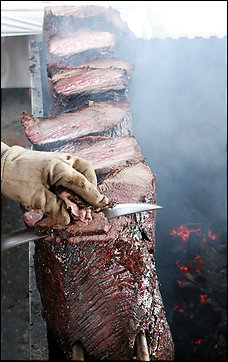
Daily Red Meat Raises Chances Of Dying Early” was the headline in the Washington Post last year. This scary story was accompanied by the photo below. The gloved hand slicing roast beef with a scalpel-like instrument was probably intended to evoke CSI autopsy scenes, although, to me, the beef still looked pretty good if slightly over-cooked.  I don’t know the reporter, Rob Stein, but I can’t help feeling that we’re not talking Woodward and Bernstein here.  For those too young to remember Watergate, the reporters from the Post were encouraged to “follow the money” by Deep Throat, their anonymous whistle-blower. A similar character, claiming to be an insider and  identifying himself or herself as “Fat Throat,” has been sending intermittent emails to bloggers, suggesting that they “follow the data.”

The Post story was based on a research report “Meat Intake and Mortality” published in the medical journal, Archives of Internal Medicine by Sinha and coauthors.  It got a lot of press and had some influence and recently re-surfaced in the Harvard Men’s Health Watch in a two part article called, incredibly enough, “Meat or beans: What will you have?” (The Health Watch does admit that “red meat is a good source of iron and protein and…beans can trigger intestinal gas” and that they are “very different foods”) but somehow it is assumed that we can substitute one for the other.

Let me focus on Dr. Sinha’s article and try to explain what it really says.  My conclusion will be that there is no reason to think that any danger of red meat has been demonstrated and I will try to point out some general ways in which one can deal with these kinds of reports of scientific information.

A few points to remember first.  During the forty years that we describe as the obesity and diabetes epidemic, protein intake has been relatively constant; almost all of the increase in calories has been due to an increase in carbohydrates; fat, if anything, went down. During this period, consumption of almost everything increased.  Wheat and corn, of course went up.  So did fruits and vegetables and beans.  The two things whose consumption went down were red meat and eggs.  In other words there is some a priori reason to think that red meat is not a health risk and that the burden of proof should be on demonstrating harm.  Looking ahead, the paper, like analysis of the population data, will rely entirely on associations.

The conclusion of the study was that “Red and processed meat intakes were associated with modest increases in total mortality, cancer mortality, and cardiovascular disease mortality.”  Now, modest increase in mortality is a fairly big step down from “Dying Early,” and surely a step-down from the editorial quoted in the Washington Post.  Written by Barry Popkin, professor of global nutrition at the University of North Carolina it said: “This is a slam-dunk to say that, ‘Yes, indeed, if people want to be healthy and live longer, consume less red and processed meat.'” Now, I thought that the phrase “slam-dunk” was pretty much out after George Tenet, then head of the CIA, told President Bush that the Weapons of Mass Destruction in Iraq was a slam-dunk.  (I found an interview with Tenet after his resignation quite disturbing; when the director of the CIA can’t lie convincingly, we are in big trouble).  And quoting Barry Popkin is like getting a second opinion from a member of the “administration.” It’s definitely different from investigative reporting like, you know, reading the article.

So what does the research article really say?  As I mentioned in my blog on eggs, when I read a scientific paper, I look for the pictures. The figures in a scientific paper usually make clear to the reader what is going on — that is the goal of scientific communication.  But there are no figures.  With no figures, Dr. Sinha’s research paper has to be analyzed for what it does have: a lot of statistics.  Many scientists share Mark Twain’s suspicion of statistics, so it is important to understand how it is applied.  A good statistics book will have an introduction that says something like “what we do in statistics, is try to put a number on our intuition.”  In other words, it is not really, by itself, science.  It is, or should be, a tool for the experimenter’s use. The problem is that many authors of papers in the medical literature allow statistics to become their master rather than their servant: numbers are plugged into a statistical program and the results are interpreted in a cut-and-dried fashion with no intervention of insight or common sense. On the other hand, many medical researchers see this as an impartial approach. So let it be with Sinha.

What were the outcomes? The study population of 322, 263 men and 223, 390 women was broken up into five groups (quintiles) according to meat consumption, the highest taking in about 7 times as much as the lower group (big differences).  The Harvard News Letter says that the men who ate the most red meat had a 31 % higher death rate than the men who ate the least meat.  This sounds serious but does it tell you what you want to know? In the media, scientific results are almost universally reported this way but it is entirely misleading.  (Bob has 30 % more money than Alice but they may both be on welfare). To be fair, the Abstract of the paper itself reported this as a hazard ratio of 1.31 which, while still misleading, is less prejudicial. Hazard ratio is a little bit complicated but, in the end, it is similar to odds ratio or risk ratio which is pretty much what you think: an odds ratio of 2 means you’re twice as likely to win with one strategy as compared to the other.  A moment’s thought tells you that this is not good information because you can get an odds ratio of 2, that is, you can double your chances of winning the lottery, by buying two tickets instead of one.  You need to know the actual odds of each strategy.  Taking the ratio hides information.  Do reporters not know this?  Some have told me they do but that their editors are trying to gain market share and don’t care.  Let me explain it in detail.  If you already understand, you can skip the next paragraph.

A trip to Las Vegas

Taking the hazard ratio as more or less the same as odds ratio or risk ratio, let’s consider applying odds (in the current case, they are very similar).  So, we are in Las Vegas and it turns out that there are two black-jack tables and, for some reason (different number of decks or something), the odds are different at the two tables (odds are ways of winning divided by ways of not winning).  Table 1 pays out on average once every 100 hands.  Table 2 pays out once in 67 hands. The odds are 1/99 or close to one in a hundred at the first table and 1/66 at the second.  The odds ratio is, obviously the ratio of the two odds or 1/66 divided by 1/99 or about 1.55.  (The odds ratio would be 1 if there were no difference between the two tables).

Right off, something is wrong: if you were just given the odds ratio you would have lost some important  information.  The odds ratio tells you that one gambling table is definitely better than the other but you need additional information to find out that the odds aren’t particularly good at either table: technically, information about the absolute risk was lost.

So knowing the odds ratio by itself is not much help.  But since we know the absolute risk of each table, does that help you decide which table to play?  Well, it depends who you are. For the guy who is at the blackjack table when you go up to your hotel room to go to sleep and who is still sitting there when you come down for the breakfast buffet, things are going to be much better off at the second table.  He will play hundreds of hands and the better odds ratio of 1.5 will pay off in the long run.  Suppose, however, that you are somebody who will take the advice of my cousin the statistician who says to just go and play one hand for the fun of it, just to see if the universe really loves you (that’s what gamblers are really trying to find out).  You’re going to play the hand and then, win or lose, you are going to go do something else.  Does it matter which table you play at?  Obviously it doesn’t.  The odds ratio doesn’t tell you anything useful because you know that your chances of winning are pretty slim either way.

Now going over to the Red Meat article the hazard ratio (again, roughly the odds ratio) between high and low red meat intakes for all-cause mortality for men, for example, is 1.31 or, as they like to report in the media 31 % higher risk of dying which sounds pretty scary.  But what is the absolute risk?  To find that we have to find the actual number of people who died in the high red meat quintile and the low end quintile.  This is easy for the low end: 6,437 people died from the group of  64,452, so the probability (probability is ways of winning divided by total possibilities) of dying are 6,437/64,452 or just about 0.10 or 10 %.  It’s a little trickier for the high red meat consumers.  There, 13,350 died.  Again,  dividing that by the number in that group, we find an absolute risk of 0.21 or 21 % which seems pretty high and the absolute difference in risk is an increase of 10 % which still seems pretty significant.  Or is it?  In these kinds of studies, you have to ask about confounders, variables that might bias the results.  Well, here, it is not hard to find.  Table 1 reveals that the high red meat group had 3 times the number of smokers. (Not 31 % more but 3 times more).  So the authors corrected the data for this and other effects (education, family history of cancer, BMI, etc.) which is how the final a value of 1.31 was obtained.  Since we know the absolute value of risk in the lowest red meat group, 0.1 we can calculate the risk in the highest red meat group which will be 0.131.  The absolute increase in risk from eating red meat, a lot more red meat, is then 0.131 – 0.10 = 0.031 or 3.1 % which is quite a bit less than we thought.

Now, we can see that the odds ratio of 1.31 is not telling us much — and remember this is for big changes, like 6 or 7 times as much meat; doubling red meat intake (quintiles 1 and 2) leads to a hazard ratio of 1.07.  What is a meaningful odds ratio?  For comparison, the odds ratio for smoking vs not smoking for incidence of lung disease is about 22.

Well, 3.1 % is not much but it’s something.  Are we sure?  Remember that this is a statistical outcome and that means that some people in the high red meat group had lower risk, not higher risk.  In other words, this is what is called statistically two-tailed, that is, the statistics reflect changes that go both ways.  What is the danger in reducing meat intake.  The data don’t really tell you that.  Unlike cigarettes, where there is little reason to believe that anybody’s lungs really benefit from cigarette smoke (and the statistics are due to random variation), we know that there are many benefits to protein especially if it replaces carbohydrate in the diet, that is, the variation may be telling us something real.  With odds ratios around 1.31 — again, a value of 1 means that there is no difference — you are almost as likely to benefit from adding red meat as you are reducing it.  The odds still favor things getting worse but it really is a risk in both directions. You are at the gaming tables.  You don’t get your chips back. If reducing red meat does not reduce your risk, it may increase it.  So much for the slam dunk.

What about public health? Many people would say that for a single person, red meat might not make a difference but if the population reduced meat by half, we would save thousands of lives.  The authors do want to do this.  At this point, before you and your family take part in a big experiment to save health statistics in the country, you have to ask how strong the relations are.  To understand the quality of the data, you must look for things that would not be expected to have a correlation.  “There was an increased risk associated with death from injuries and sudden death with higher consumption of red meat in men but not in women.”  The authors dismiss this because the numbers were smaller (343 deaths) but the whole study is about small differences and it sounds like we are dealing with a good deal of randomness.  Finally, the authors set out from the start to investigate red meat.  To be fair, they also studied white meat which was slightly beneficial. But what are we to compare the meat results to? Why red meat?  What about potatoes?  Cupcakes?   Breakfast cereal?  Are these completely neutral? If we ran these through the same computer, what would we see?  And finally there is the elephant in the room: carbohydrate. Basic biochemistry suggests that a roast beef sandwich may have a different effect than roast beef in a lettuce wrap.

So I’ve given you the perspective of a biochemistry professor.  This was a single paper and surely not the worst, but I think it’s not really about science.  It’s about sin.

*

Nutrition & Metabolism Society

Charles Darwin, in his autobiography described

“the oddest case which I have known. A gentleman (who, as I afterwards heard, is a good local botanist) wrote to me from the Eastern counties that the seed or beans of the common field-bean had this year everywhere grown on the wrong side of the pod. I wrote back, asking for further information, as I did not understand what was meant; but I did not receive any answer for a very long time. I then saw in two newspapers, one published in Kent and the other in Yorkshire, paragraphs stating that it was a most remarkable fact that ‘the beans this year had all grown on the wrong side.’ So I thought there must be some foundation for so general a statement.”

I had read this passage a while ago but it suddenly popped up in my mind on reading the new USDA Dietary Guidelines. The Guidlines have a strong recommendation to choose “nutrient dense” food.  Since all the food you ingest contains some kind of macronutrient or micronutrient  and having a food dense in one or another would depend on how much you thought was good I could not really understood what was meant.  I pretty much forgot about it until I saw in a video from a TV broadcast making the same recommendation suggesting that it was intelligible to the general population. I still couldn’t understand what could be meant. The guidelines say, on page 3, “Energy-dense forms of foods, especially foods high in SoFAS, should be replaced with nutrient-dense forms of vegetables…” SoFAs stands for “solid fats and added sugars.” It would be hard to find two more nutrient dense but different substances. So at least nutrient dense is not calorie dense but it is not obvious what it is.  Note added in 2013:when I first posted this, I genuinely did not know that nutrient-dense now means micronutrient-dense but I think the critique of the USDA still stands and for a description of currency of an idea that has no real meaning at all, Darwin’s story is still the best. (And, of course, vitamin deficiencies may be the least of our nutritional problems).

Darwin described how he

“went to my gardener, an old Kentish man, and asked him whether he had heard anything about it, and he answered, ‘Oh, no, sir, it must be a mistake, for the beans grow on the wrong side only on leap-year, and this is not leap-year.’ I then asked him how they grew in common years and how on leap-years, but soon found that he knew absolutely nothing of how they grew at any time, but he stuck to his belief. After a time I heard from my first informant, who, with many apologies, said that he should not have written to me had he not heard the statement from several intelligent farmers; but that he had since spoken again to every one of them, and not one knew in the least what he had himself meant. So that here a belief–if indeed a statement with no definite idea attached to it can be called a belief–had spread over almost the whole of England without any vestige of evidence.”

(In case you think that there is any botanical meaning at all: it is not just the leap-year. It is that there is no right or wrong side of the pod at all).  Is it possible that the USDA guidelines, put together by the famous 13 experts have made a recommendation that was completely devoid of meaning?  Page 11 says that “A nutrient-dense total diet has multiple health benefits and can be implemented in various ways” but what is nutrient-dense?  Although never defined, examples are given on pages 19-20.

• Vegetables, fruits, high-fiber whole grains

• Fat-free or low-fat fluid milk and milk products

• Seafood, lean meat and poultry, eggs, soy products, nuts, seeds, and oils

• Very low in solid fats and added sugars (SoFAS)

• Reduced in sodium

The remarkable thing is that in five out of six, the nutrient density is attained by absence of nutrients: fat-free, low-fat, lean, very-low SoFAS, reduced sodium — and is there anything less dense than skim-milk?  Paraphrasing Darwin, then, here is a dietary recommendation –if indeed a statement with no definite idea attached to it can be called a recommendation — will be spread over almost the whole of the country without any vestige of evidence.

I don’t believe in time travel, of course, so when somebody sent me the following article that was supposed to be a chapter from a Study of the History of Diabetes published in 2018, I didn’t think about it much.  Then I read an article about a woman who had been charged with neglect in the death of her son from complications due to diabetes.  It seems she “was trying to live by faith and felt like God would heal him.”

For some reason, that made me think of the Future History, so here is a chapter from the History.

Chapter IV.  ACCORD to The Court

We have seen how, early in the history of medicine, diabetes was recognized as a disease of carbohydrate intolerance and how, until the discovery of insulin, removing carbohydrate from the diet became the major treatment (Chapters I and II).  We chronicled the shift away from this medical practice under the influence of low fat recommendations and the ascendancy of pharmacology that followed the discovery of insulin.  Nonetheless, it persisted in the popular mind that you don’t give candy to people with diabetes, even as health agencies seemed to encourage sucrose (sugar) consumption.

The rather sudden reappearance of carbohydrate restriction, the so-called modern era in diabetes treatment, is usually dated to 2008, the precipitating event, publication of the ACCORD study in which a group undergoing  “intensive treatment” to lower blood glucose showed unexpected deaths [1].  ACCORD concluded that “These findings identify a previously unrecognized harm of intensive glucose lowering in high-risk patients with type 2 diabetes.” The intensive treatment turned out to be intensive pharmacologic therapy and this flawed logic lead to a popular uprising of sorts, a growing number of patients claiming that they had been hurt by intensive drug treatment and typically that they had only been able to get control of their diabetes by adherence to low carbohydrate diets. Blogs compared the ACCORD conclusion to an idea that alleviating headaches with intensive aspirin led to bleeding and we should therefore not treat headaches.

The conflict culminated in the large judgment for the plaintiff in Banting v. American Diabetes Association (ADA) in 2017, affirmed by the Supreme Court in 2018.  Dalton Banting, coincidentally a distant relative of the discoverer of insulin, was an adolescent with diabetes who took prescribed medications and followed a diet consistent with ADA recommendations.  He experienced worsening of his symptoms and ultimately had a foot amputated. At this point his parents found a physician who recommended a low carbohydrate diet which led to rapid and sustained improvement.  The parents claimed their son should have been offered carbohydrate-restriction as an option.  The case was unusual in that Banting had a mild obsessive-compulsive condition, expressed as a tendency to follow exactly any instructions from his parents or other authority figures.  Banting’s lawyers insisted that, as a consequence, one could rely on his having complied with the ADA’s recommendations.  Disputed by the defense, this was one of several issues that made Banting famous for vituperative courtroom interactions between academics.

Banting was a person with type 2 diabetes.  Unlike people with type 1 diabetes, he was able to produce insulin in response to dietary (or systemic) glucose but his pancreas was progressively dysfunctional and his body did not respond normally, that is, he was insulin-resistant.  Although most people with type 2 diabetes are at least slightly overweight, Banting was not, although he began gaining weight when treated with insulin.

The phrase “covered with insulin…” rocked the court: the president of the ADA, H. Himsworth, Jr., was asked to  read from the 2008 guidelines [2], never rescinded: “Sucrose-containing foods can be substituted for other carbohydrates in the meal plan or, if added to the meal plan, covered with insulin or other glucose lowering medications.”

Jaggers (attorney for Banting): “Are there other diseases where patients are counseled to make things worse so that they can take more drugs.”

Himsworth: “We only say ‘can be.’  We don’t necessarily recommend it.  We do say that ‘Care should be taken to avoid excess energy intake.’”

It soon became apparent that Himsworth was in trouble.  He was asked to read from the passage explaining the ADA’s opposition to low carbohydrate diets:

“Low-carbohydrate diets might seem to be a logical approach to lowering postprandial glucose. However, foods that contain carbohydrate are important sources of energy, fiber, vitamins, and minerals and are important in dietary palatability.”

Jaggers: “Important sources of energy?  I thought we wanted to avoid excess energy,” and “would you say that taking a vitamin pill is in the same category as injecting insulin?”

Finally,

Jaggers: “Dr. Himsworth, as an expert on palatability, could you explain the difference between Bordelaise sauce and Béarnaise sauce?” [laughter]

Damaging as this testimony was, the tipping point in the trial is generally considered to have been the glucometer demonstration.  Banting consumed a meal typical of that recommended by the ADA  and glucometer readings were projected on a screen for the jury, showing, on this day, so-called “spikes” in blood glucose.  The following day, Banting consumed a low carbohydrate meal and the improved glucometer readings were again projected for the jury.  Defense argued that one meal did not prove anything and that one had to look at the whole history of the lifestyle intervention but was unable to show any evidence of harm from continued maintenance of low blood sugar despite testimony of several expert witnesses.  In the end, the jury agreed that common sense overrides expert testimony and that Banting should have been offered the choice of a carbohydrate-restricted diet.

Banting was held in New York State which adheres to the Frye standard: in essence, the idea that scientific evidence is determined by “general acceptance.” The explicit inclusion of common sense was, in fact, a legal precedent [3].   The Supreme Court ultimately concurred and held that the more comprehensive standards derived from Daubert v. Merrill-Dow, could sensibly be seen to encompass common sense.

The final decision in Banting lead to numerous law suits.  The ADA and other agencies changed their tactics claiming that they never were opposed to low carbohydrate diets and, in fact, had been recommending them all along [4].  This is discussed in the next chapter.

References

1. Gerstein, H. C. et al., Effects of intensive glucose lowering in type 2 diabetes. N Engl J Med 358 (24), 2545 (2008).

2. American Diabetes Association, Nutrition Recommendations and Interventions for Diabetes–2008. Diabetes Care 31 (Suppl 1), S61 (2008).

3. Berger, M, Expert Testimony: The Supreme Court’s Rules Issues in Science and Technology (2000).

4. American Diabetes Association, Nutrition Recommendations and Interventions for Diabetes–2018. Diabetes Care 40 (Suppl 1), S12 (2018).

The headline read “Vascular effects of a low-carbohydrate high-protein diet.”   The article, as anticipated, was trying to trash low carb diets. This is not uncommon. Those of us who work in the field are used to it.  Low carbohydrate diets are the thing that doctors and nutritionists love to hate.  Every junior faculty in a medicine department feels obligated to write a review showing how bad such diets are, frequently by saying that they don’t conform to the recommendations of the USDA, an example of what was the original meaning of “begging the question”, namely assuming the question in deducing the answer, that is: The USDA guidelines defines healthy diets. The Atkins diet says that the USDA guidelines are bad.  The Atkins diet does not conform to the USDA guidelines. The Atkins diet is unhealthy. QED.

The paper in question, however, turned out to be especially infuriating, claiming that a low-carbohydrate  diet will cause the build-up of plaque that is characterized as atherosclerosis but the experiment was absurd.   It reminded me of the kind of articles that William F. Buckley, Jr. used to write, the kind that made you wonder: does he really not see how illogical this stuff is.  By coincidence the low carb-atherosclerosis paper appeared about the same time as Gary Wills’s portrait of Buckley appeared in the Atlantic.  It was a very sympathetic review although Wills was not blind to Buckley’s faults.  I saw in Buckley’s personality this same kind of thing that was in the atherosclerosis paper. I understood pleasure in being infuriating but you can always do that while trying to get it right. I suddenly had some perspective on it all. I could see a mindset where the truth was not the main reinforcer as we say in behavioral psychology.  Buckley was simply motivated by something else. So first, I’ll tell you about the low carbohydrate diet paper.

The thing that drives the nutritional establishment crazy is not that low carbohydrate are effective for weight loss. Everybody knows that. The earliest writers on food, Brillat-Savarin for example, made the observation that the principles of fattening your pig for market by feeding her grains applied to humans as well. What gets people nuts is that the cardiovascular risk that was supposed to follow from the increase in fat did not materialize.  In fact, when actually studied, low carbohydrate diets reduced cardiovascular risk, dramatically lowering triglycerides (fat in the blood), increasing HDL (the so-called “good cholesterol”)  and improving other risk factors.  In fact, the paper by Foo, et al. in PNAS admitted “randomized trials suggest low-carbohydrate diets may accelerate weight loss with surprisingly little negative effect on serum markers of cardiac risk such as cholesterol,” but that didn’t stop the authors who were able to come up with new warnings about atherosclerosis from low-carbohydrate diets.

It wasn’t people, that developed atherosclerosis. It turns out that the low-carbohydrate diet was administered to mice.  Now this could be news since mice are not particularly susceptible to atherosclerosis possibly because they have high HDL (again, the “good cholesterol”). But this was not your ordinary mouse.  This was a mouse that was genetically engineered to be susceptible to cardiovascular disease.  This was an apoE-knockout mouse, a mouse  from which the genes for apolipoprotein E had been deleted ((ApoE-/-).  Apolipoprotein E (apoE) is one of the protein components of the cholesterol and fat-carrying particles known as lipoproteins (LP) that circulate in the blood. It is required for efficient clearance of some of these particles. One wit on the internet suggested that giving an apoE knock-out mouse atherosclerosis was the behavioral equivalent of teaching a cat to go to sleep.  Did the authors not know this was nonsense?  Did they really believe that a low carbohydrate diet had more biological importance than a difference in species and a mutation that predisposed to atherosclerosis? What were they thinking? At stake is the corruption of science and the the corruption of medicine. The coincidental appearance of Wills’s picture of Buckley was helpful:

“Bill was considered an elitist because he loved to use big words. But he did it not from hauteur but from impishness. This was part of his playfulness. He liked to play games in general, and word games were especially appealing to him. He used the big words for their own sake, even when he was not secure in their meaning. One of his most famous usages poisoned the general currency, especially among young conservatives trying to imitate him. They took oxymoron in the sense he gave it, though that was the opposite of its true meaning. He thought it was a fancier word for “contradiction,” so young imitators would say that “an intelligent liberal” was an oxymoron. But the Greek word means “something that is surprisingly true, a paradox,” as in a shrewd dumbness.”

That was it.  The Beth Israel doctors were just having fun.  But cardiology is a serious business and this couldn’t be a pattern but this was a context where getting it right counted.  Atkins was a threat and the truth wasn’t really part of the game.  Wills said that  Buckley “never considered himself an intellectual” as he was always a risk taker.  His debate-team style was not really about the truth.  He certainly gave the impression that he thought he was an intellectual but it turns out that, in the end, he was just screwing around.

So what do Dr. Foo and Dr. Rosenzweig actually believe?  The press release from Beth Israel said that Rosenzweig went off his Atkins diet because his resident Dr. Foo kvetched at him in the hospital cafeteria.  You have to wonder why he went on the diet in the first place.  A recent survey showed that physicians were more likely to recommend low fat diets to their patients while using low carbohydrate diets themselves, although maybe it is easy to talk them out of it. A survey of physicians’ knowledge was also informative. In fact most physicians did not know that low-fat diets increased triglycerides or that carbohydrates are most likely to increase them.  The exception was cardiologists who were aware of these facts.  So maybe it wasn’t surprising that Rosenzweig would have been on the low carbohydrate diet.  That he went off it does suggest that he is as cavalier with his own health as with that of his patients and the readers of PNAS.  In the end, though, this does real harm.  At least for people with diabetes, control of carbohydrates can be life-saving. Buckley at least functioned in the area of journalistic politics whose standards are ambiguous at best.  In the comparison to the Beth Israel doctors, William F. Buckley comes off as rather likable, surely an oxymoron.